
Home » Articles posted by Leonide Martin (Page 3)
Author Archives: Leonide Martin

Maya Exhibit: Ceramics, Art & Adornment
Balboa Park, San Diego Museum of Natural History.
While in San Diego for the holidays in December, 2016, I spent a mesmerizing afternoon in the Maya Exhibit at the Museum of Natural History, Balboa Park. This wonderful display of Maya monuments, ceramics, and art had many original pieces on loan from other institutions, as well as reproductions of murals and larger monuments. In this blogpost, I’ll focus on ceramics, adornment and artwork.

Clay Vase with Effigy
Ceramics
The Mayas produced a wide variety of beautiful and intricately designed ceramics. Artists were allowed quite a free range of expression, their designs varying from one workshop to another. Artistic quality was more valued than adherence to standardized forms, and certain artists’ works were in high demand among elite. Some artists signed their works, or named the bowls for their owners and functions: “The cacao drinking vase of Ahau Ukib.” These vessels with detailed scenes were used in the form of straight-sided beakers for drinking chocolate mixed with chili peppers, or as bowls for food. Often they
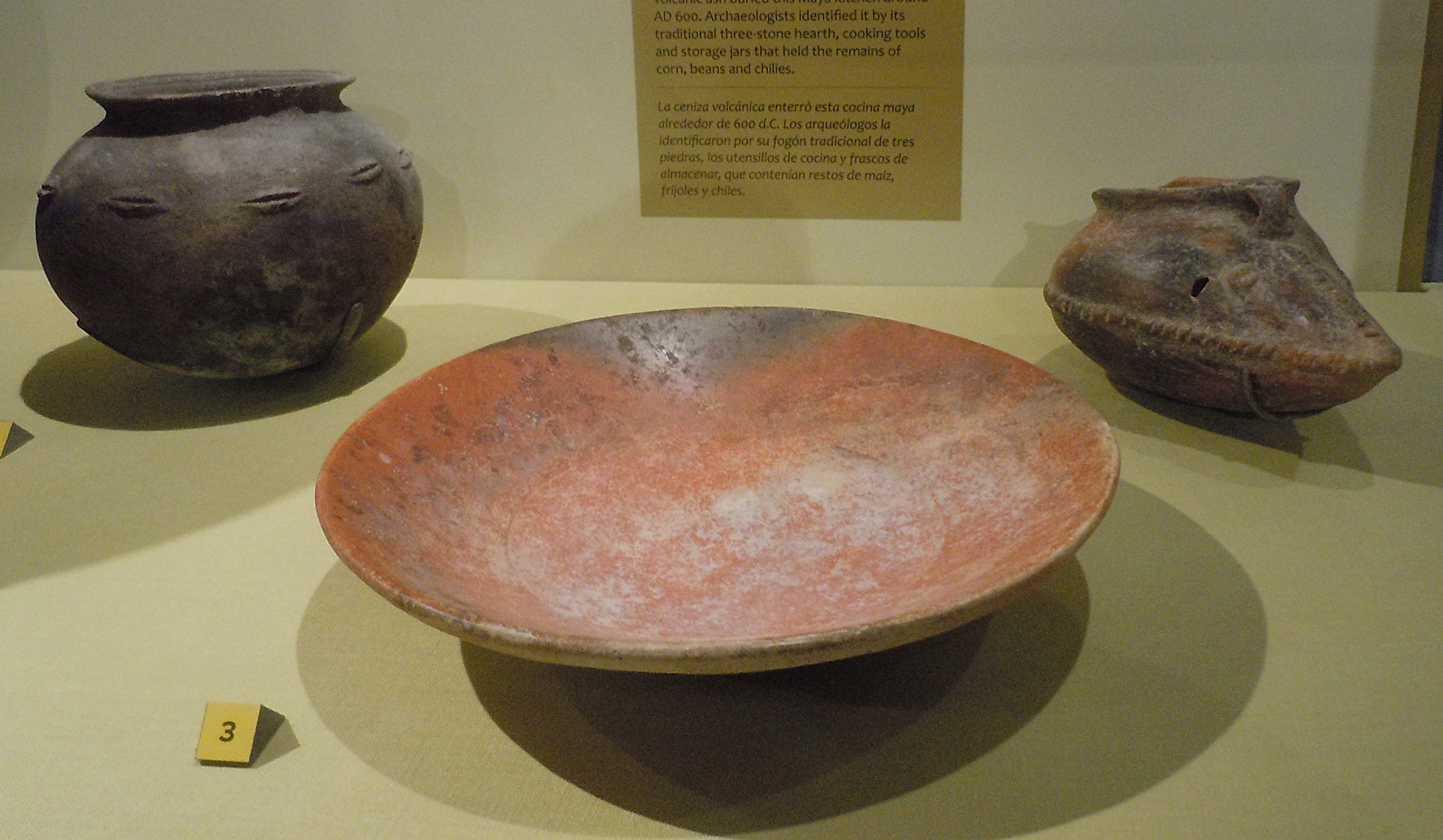
Simple Clay Vessels
were used as grave offerings in the tombs of their owners. Simpler and more utilitarian vessels were used by commoners.
To produce pottery, the Mayas used a device that rotated between the potters’ feet, called a kabal. An early ceramic style, called Amyan, appeared in the Guatemalan highlands around 1,000 BCE. It was monochrome with simple design. Originally the Mayas used gourds cut into cup and bowl shapes, and the first ceramics resembled gourds. These were decorated with rocker stamps and simple slips for color. By the Early Classic (250-550 CE) the ceramic style Tzakol developed with more complex jars, plates, bowls and vases having polychrome decorations. This style evolved into Tepeu of the Late Classic (550-700 CE) with more elaborate scenes and color variations. The polychrome slip paint was of various colors, made from plant and mineral sources. Predominant colors are red, orange, black, brown, yellow and cream. These two ceramic styles are considered the most beautiful made in ancient Mesoamerica, primarily depicting animal deities, grotesque monsters, nobles and priests, ceremonial activities, and scenes of sacrifice. New shapes were developed, including the lidded basal flange bowl, which usually had a knob on top in the form of an animal or human head. The painted body of this being often spreads across the pot. Many also had tetrapod legs for support, called “mammiform” since they resembled animal or human legs.
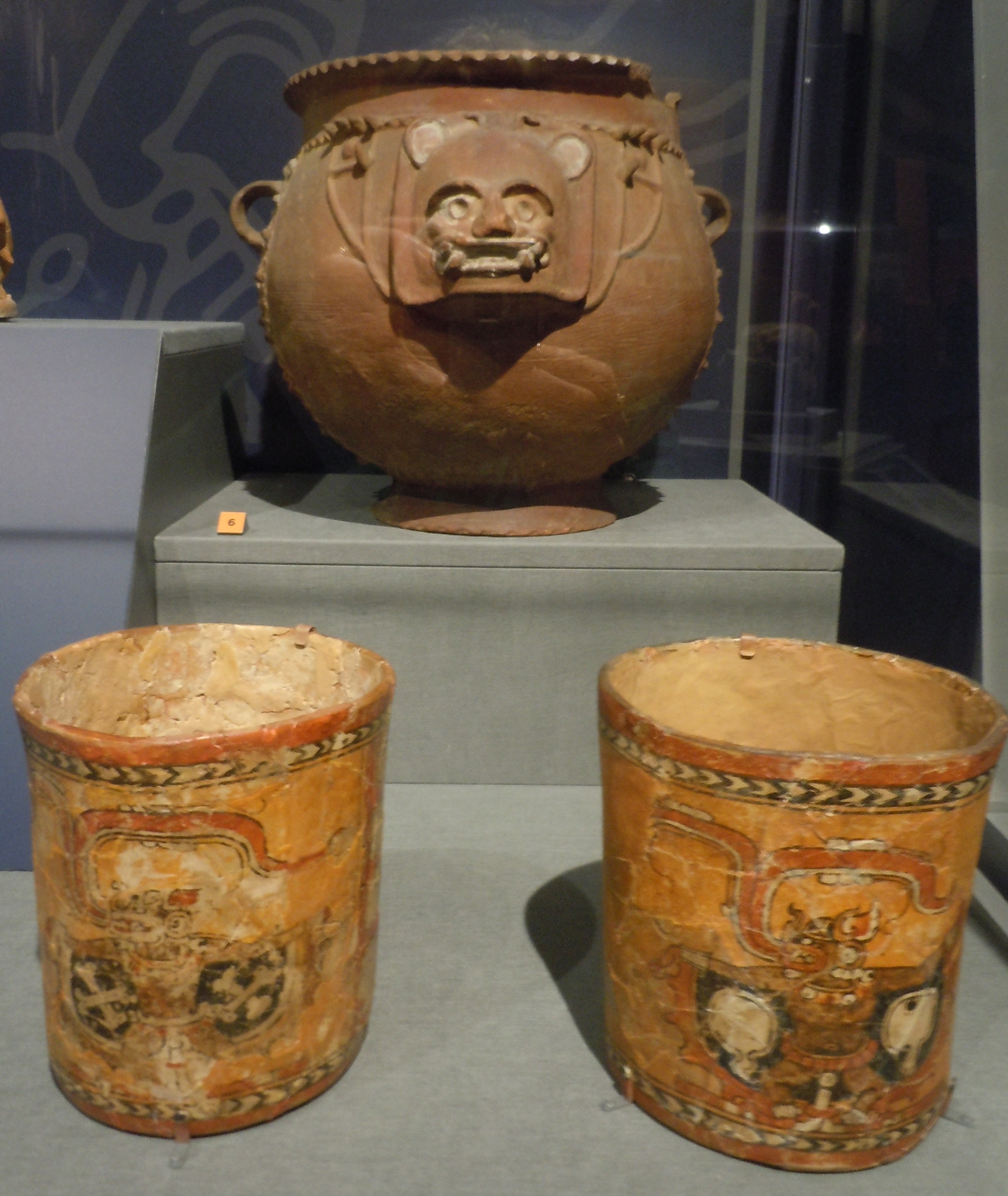
Polychrome Cups and Decorated Bowl
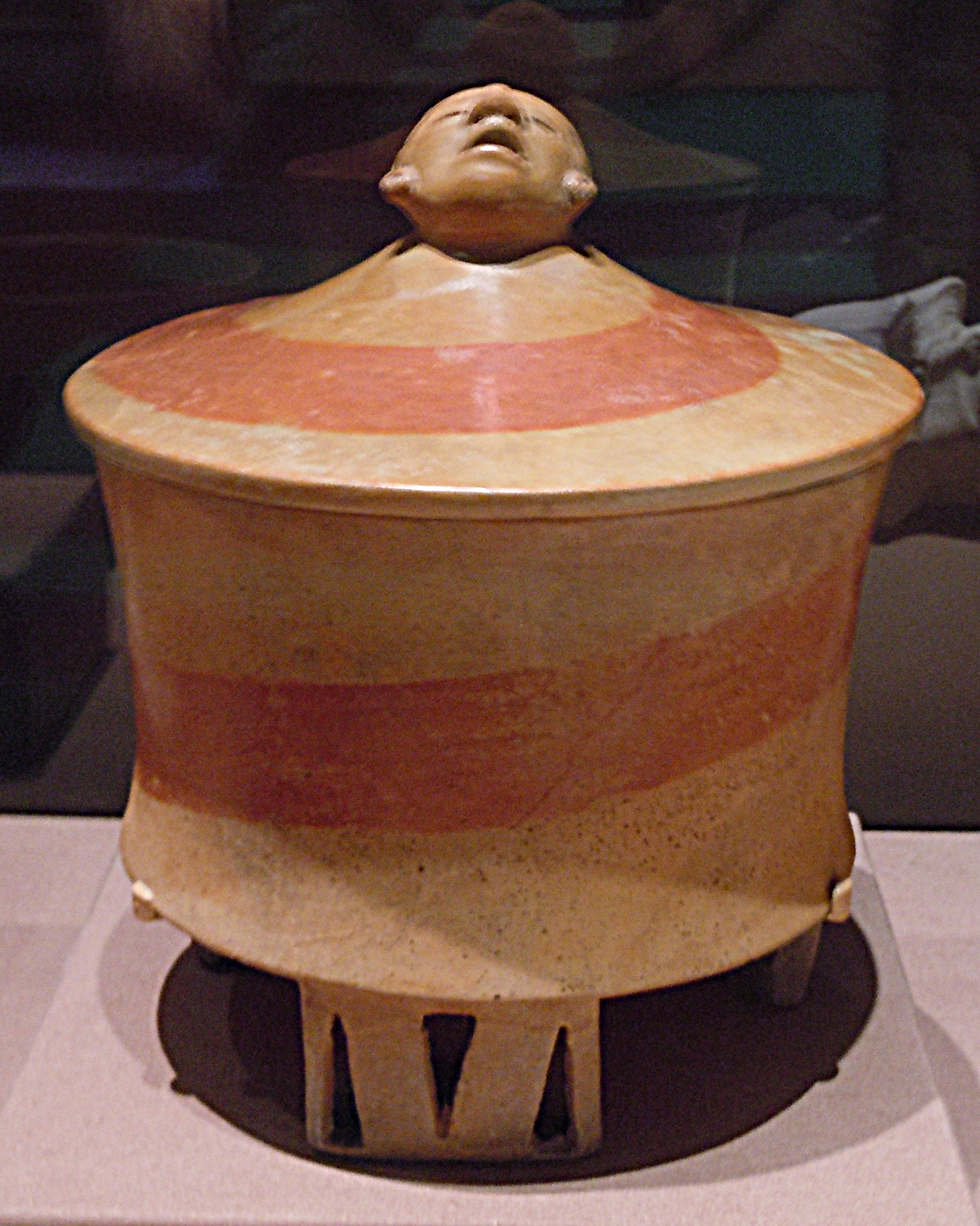
Tripod Vase with Human Head, Teotihuacan
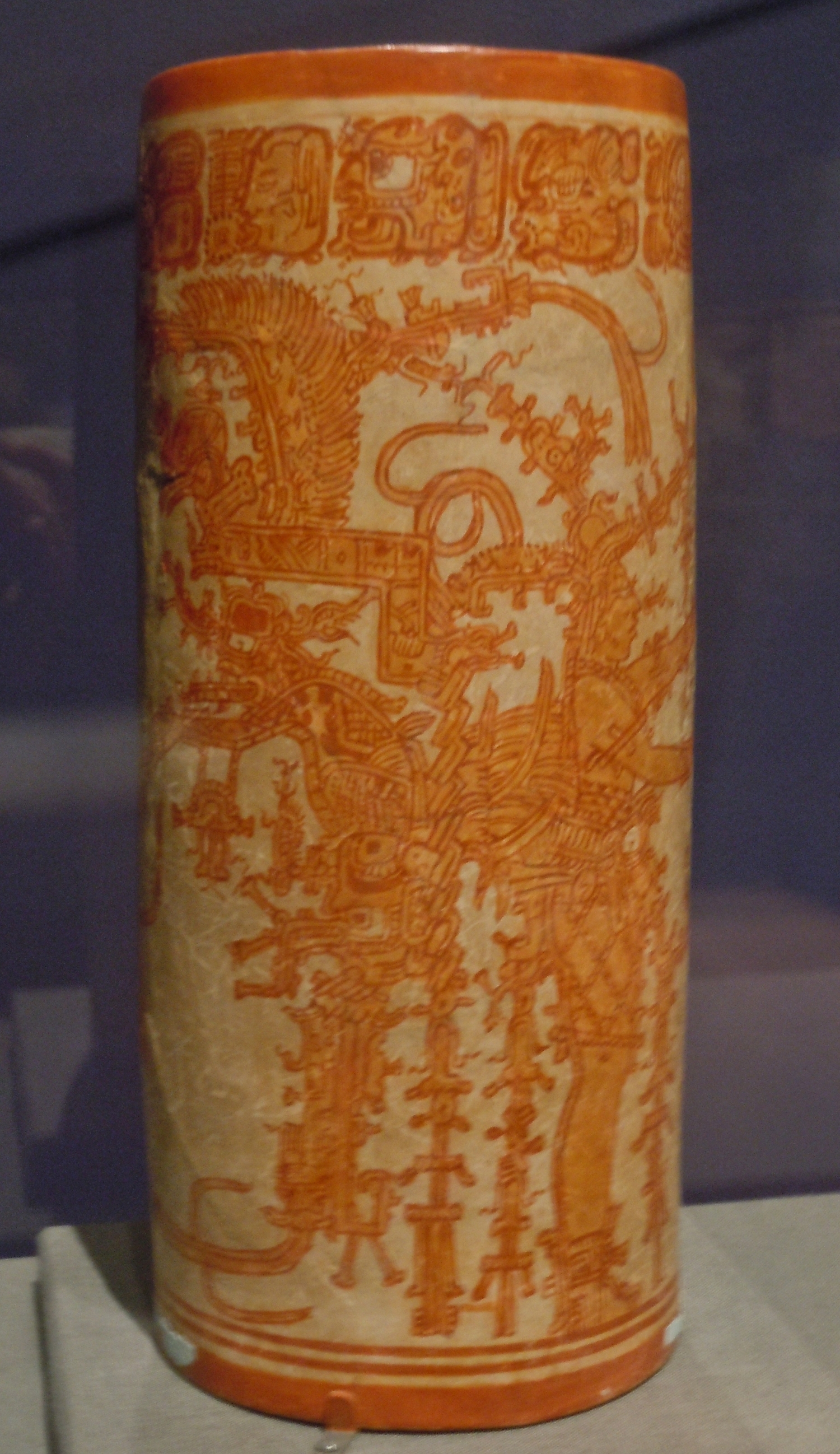
Straight-sided Drinking Cup, Orange on Cream Slip
An especially valued polychrome called “Codex style” was produced during the late Classic re-occupation of the pre-Classic sites El Mirador and Nakbe in Guatemala. These ceramics are characterized by scenes and glyphic texts drawn in dark lines on cream-colored backgrounds, usually framed by red bands on the
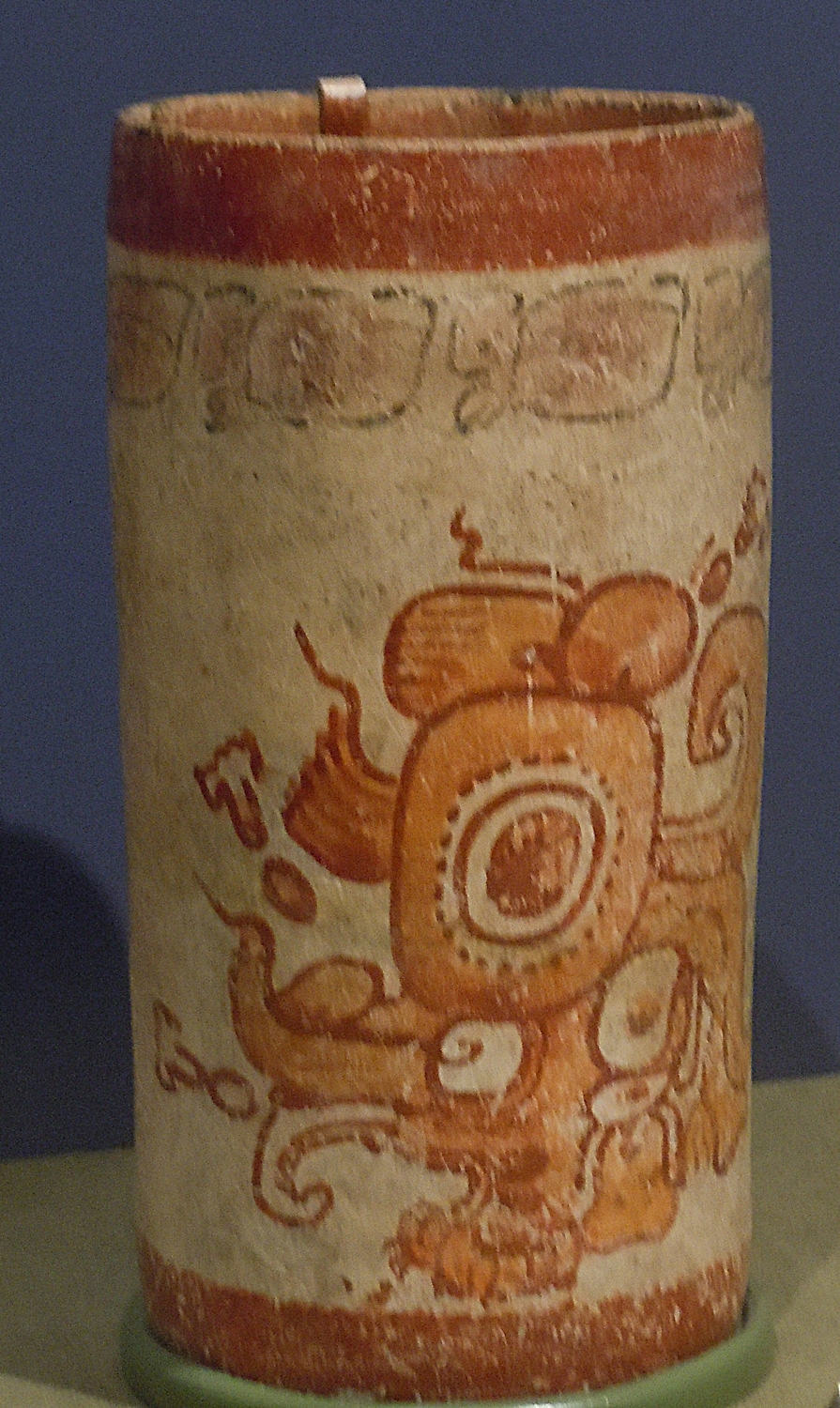
Polychrome Codex-style Vase
edges of the vessels. This gives them a resemblance to the post-Classic Maya Codex texts. This fine painted Codex-style pottery depicts extraordinary mythological scenes, and is highly sought by antiquities collectors, accounting for extensive looting of house mound complexes in Peten. In ancient times, these ceramics were in demand by elites, and have been found throughout the Maya regions.
Figurines and Effigies
The Mayas created many small figurines, busts and effigies that represented deities, specific individuals, symbolic monsters or creatures, or roles in society. Materials used to create them include clay, limestone, sandstone, trachyte, wood, jade, bone, shell, and copper. Very few artifacts were made of gold. As these often depict typical activities of ancient Maya life, archaeologists have learned much about costumes, musical instruments, religious rituals, household customs, ballgames, warfare and sacrifice. Among the most well known figurines are those from Jaina, an island off the coast of Campeche, Mexico, used for elite burials.

Figurine of Ruler in Bloodletting Position

“Incensario” Effigy of God, for Burning Incense
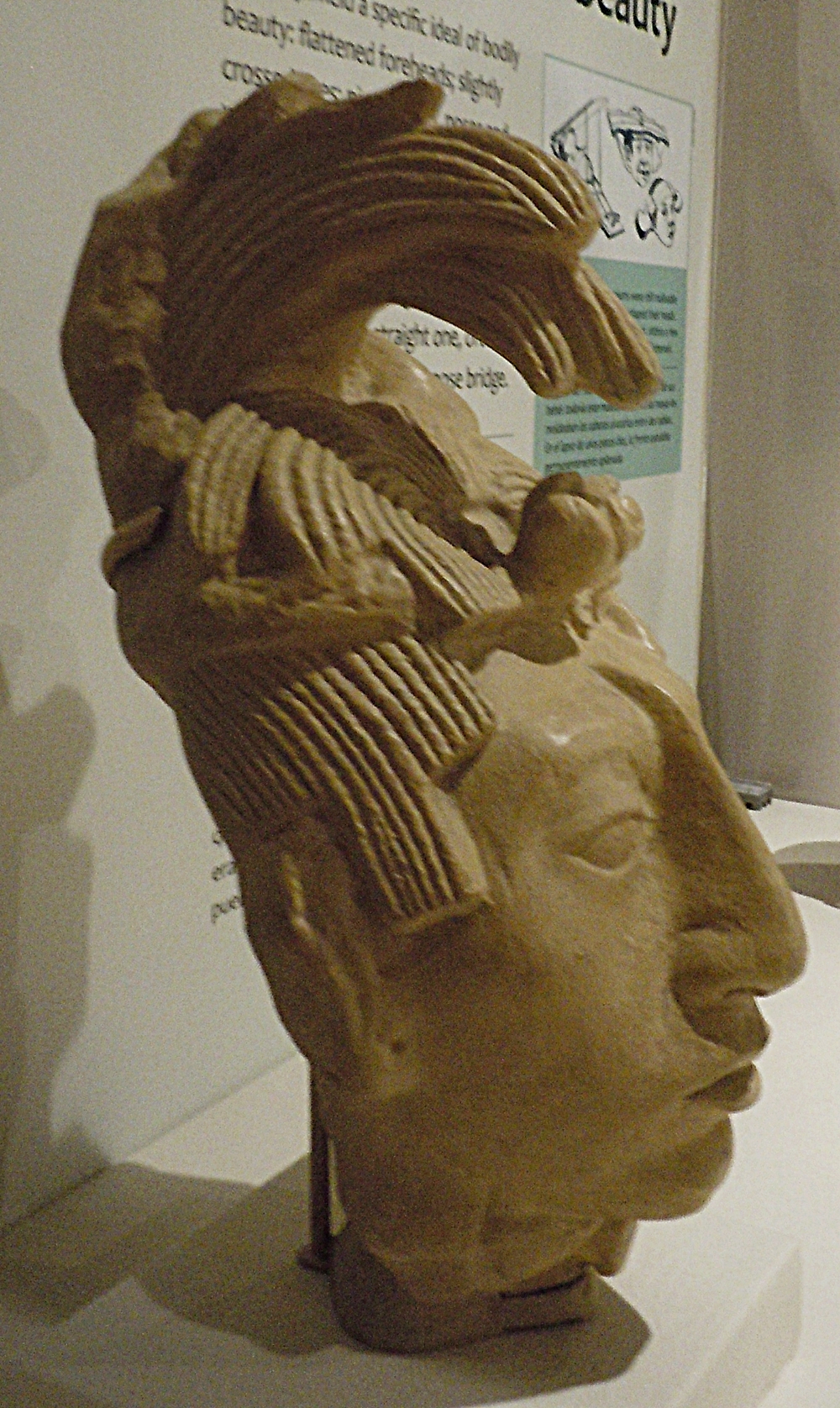
Bust of Janaab Pakal, Ruler of Palenque
Figurines were painted with the usual plant and mineral pigments. A unique shade of blue appears on some figurines, and in many murals and codices. Called “Maya blue,” it is the most durable Maya color and has only recently been reproduced. The ancient Mayas combined skills in organic chemistry and mineralogy in their technique for creating Maya blue. The pigment is a composite of organic and inorganic constituents, primarily indigo dyes derived from the leaves of the anil (Indigofera) plant, combined with palygorskite, a natural clay. The mix is cooked at low temperature (100 degrees C) until its color turns from blackish to this exquisite sky blue. Other trace elements are present, including copal incense, leading to the idea that producing Maya blue was a sacred process. Copal, resin of a native tree, is dried into incense and burned in symbolic “incensarios” during ceremonies. Using copal in making Maya blue produces the low heat necessary, and imbues the pigment with sacred qualities.
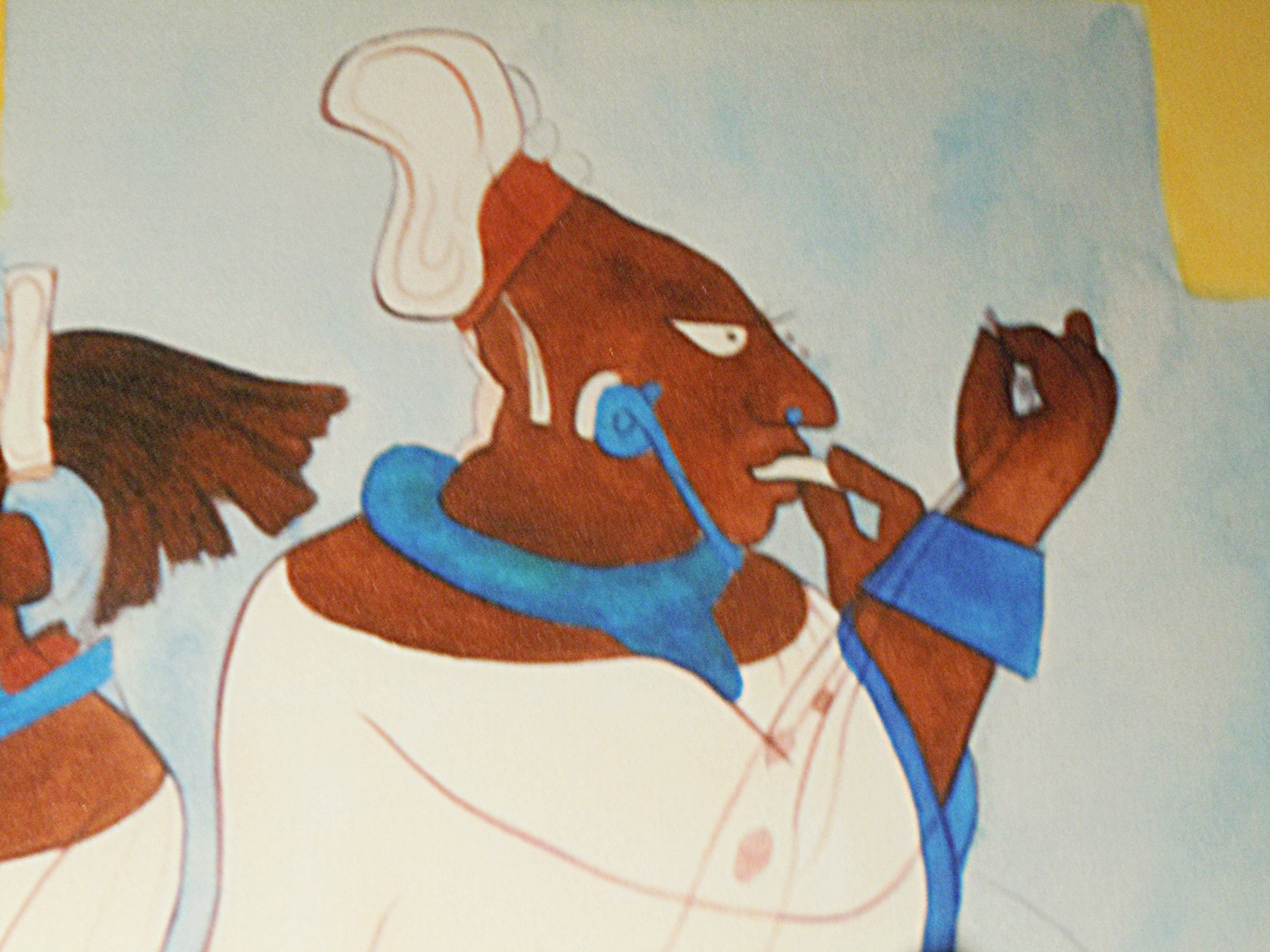
Royal Woman Wearing Maya Blue Adornments
Bonampak Murals
Jewelry and Body Decoration
Body adornment was very important to ancient Mayas. They dressed in lavish costumes, wore huge and heavy jewelry, wore complex headdresses with feathers and decorations, had earplugs that needed a balance weight behind, and often embedded gems in their teeth. Facial scarification was also used along with body painting. The Mayas excelled in working with jade, which was highly prized, as it represented the green vibrancy of new plants and the azure of water. Excavations of tombs have yielded large amounts of jade jewelry, mosaics, masks, effigies, plaques and small figures. Royal burials rich in these items have been found in several Maya sites, particularly Palenque, El Peru-Waka, and Tonina. Metal work did not make a significant appearance until after 900 CE, the Post-Classic Period. The Mayas mostly worked in copper, with a small amount of gold appearing as bowls, cups, rings, and effigies. Other items made from copper include bells, tweezers, axes, earplugs, rings, discs, and small masks.
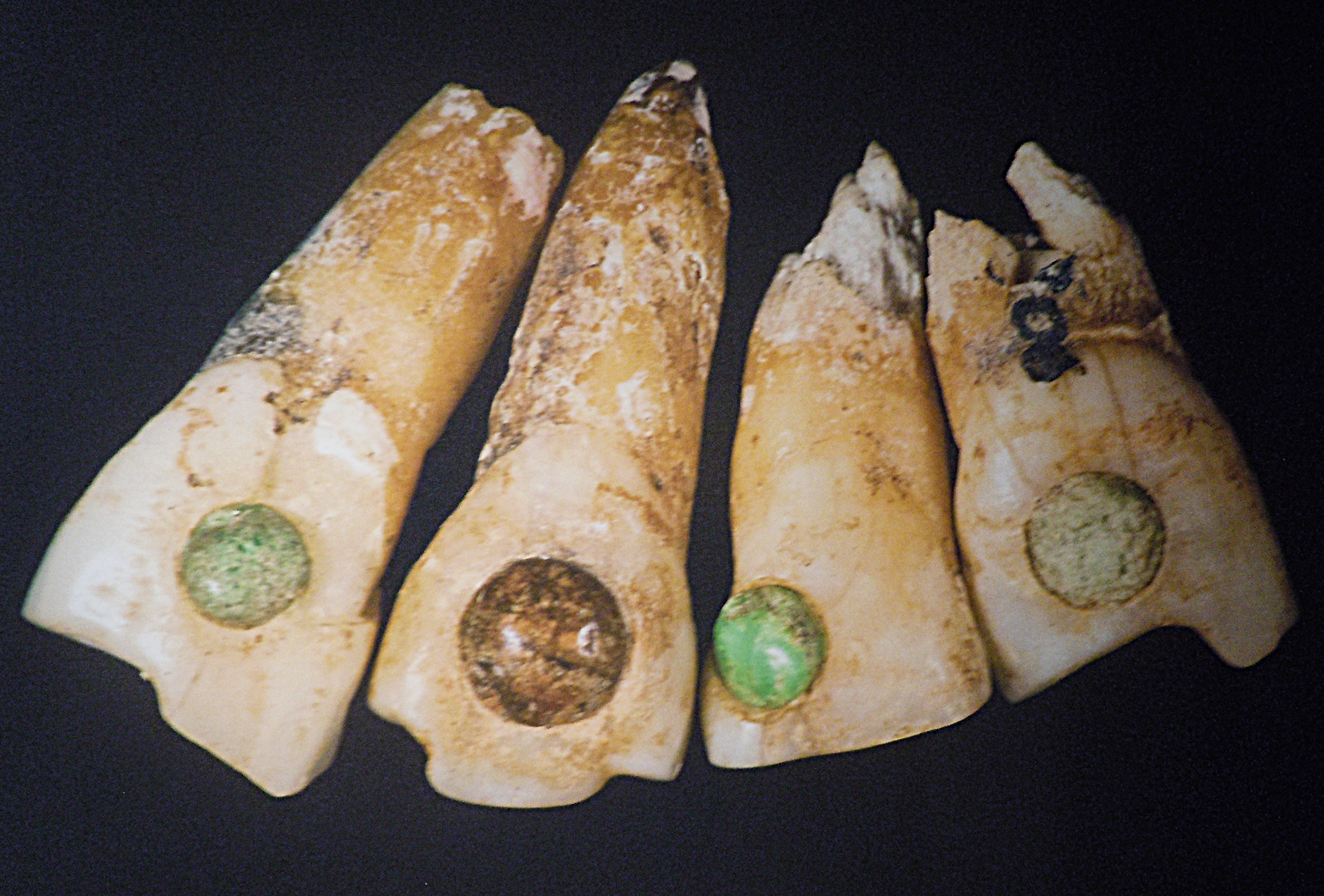
Teeth Embedded With Jade and Stones
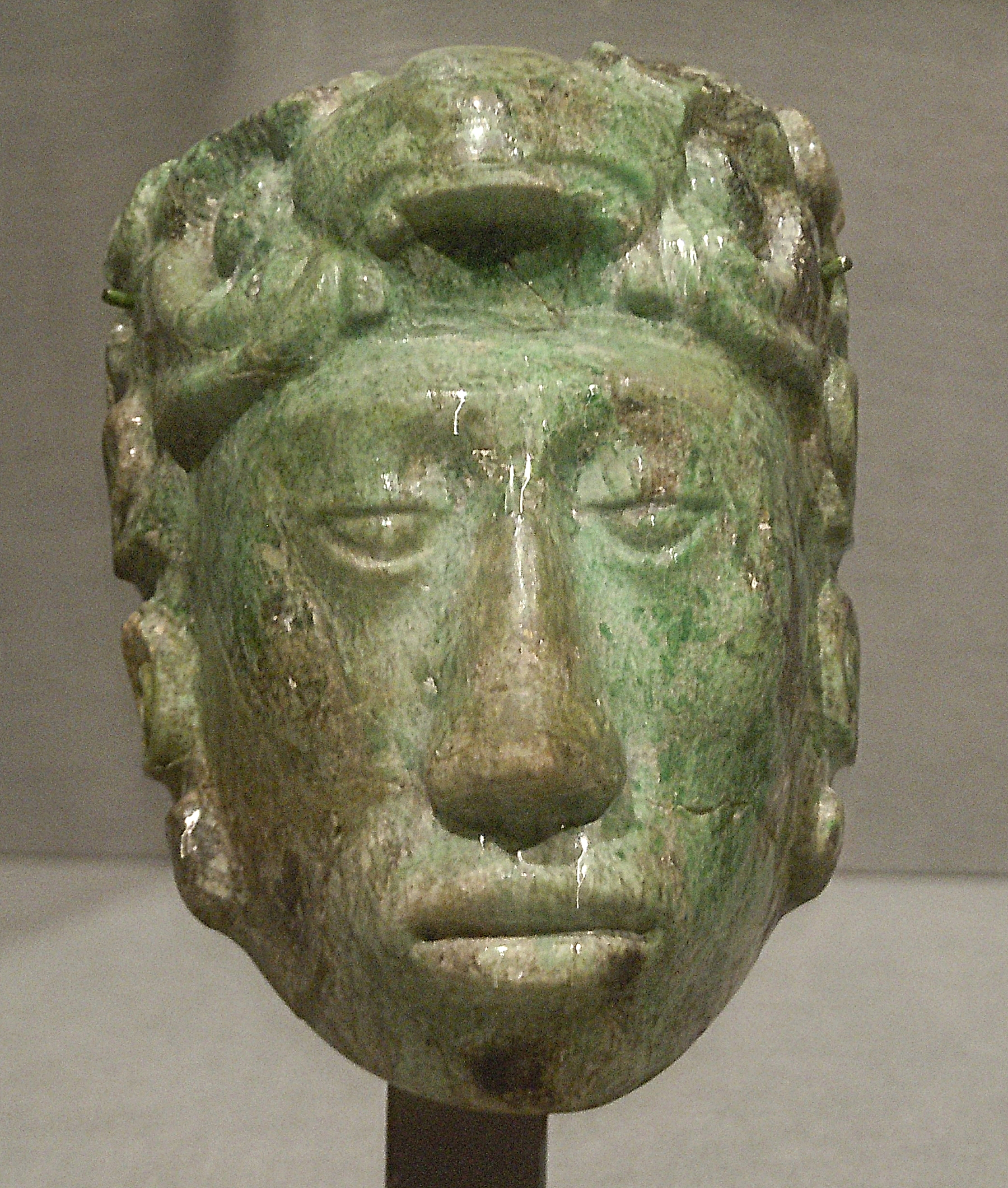
Small Jade Mask of Maya Noble

Jade Necklace

Maya Exhibit: Murals and Monuments

Balboa Park, San Diego Museum Complex
Maya Exhibit: Murals and Monuments
Balboa Park, San Diego Museum of Natural History
In December, 2016, while spending holidays with family in San Diego, I was fortunate to find a Maya exhibit at the Museum of Natural History in Balboa Park. After warning my family that I would spend hours perusing the exhibit, camera in hand, I was not surprised that no one wanted to accompany me. Alone and mesmerized by the wonderful display of Maya monuments, ceramics and art, I spent a most enjoyable afternoon. Many original pieces were on exhibit, loaned from other institutions, as well as reproductions of murals and larger monuments. In this blogpost, I’ll focus on murals and monuments, with other posts to follow for ceramics and artwork.

San Bartolo Mural
The Murals at San Bartolo, Guatemala
In 2001 William Saturno, of the University of New Hampshire and Harvard’s Peabody Museum, found an entrance into buried chambers while seeking shade. He ducked into a looters’ trench in an unexcavated pyramid, and when he shone his flashlight on the walls, he saw an elaborate, finely-painted mural. Called “Las Pinturas,” the structure’s murals were dated from 100 BCE and showed mythological scenes related to the origin of kings. Later excavations revealed additional murals, called a masterpiece of ancient Maya art. The 30 x 3 foot mural on the west wall reveals the Maya story of creation, the mythology of kingship and divine right of kings, and depicts two coronation scenes—one mythological and the other an actual king’s coronation. Other discoveries at the site include the oldest known Maya royal burial, around 150 BCE, and significantly older painted polychrome murals in a deeper chamber with Maize God images, dated around 200—400 BCE. Glyphs within the murals date to centuries before most other Maya texts, and remain hard to read. David Stuart of the University of Texas at Austin, leading Maya epigrapher, said one scene names a young god as “star man” and emphasizes his cosmological role within the larger creation myth represented.
The San Bartolo mural featured at Balboa Park is the scene of the Maya creation myth, the first known depiction in narrative form, according to Karl Taube, University of California, Riverside, an expert in ancient Mesoamerican history.
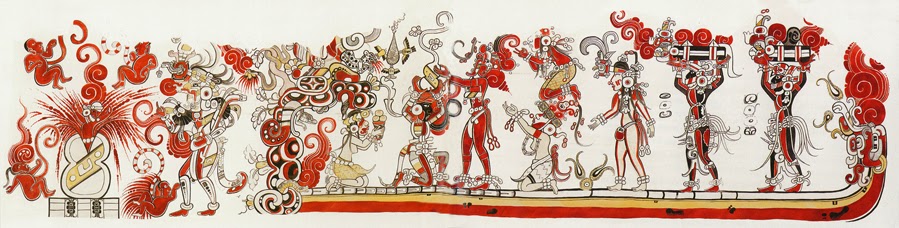
San Bartolo Mural Redrawn from Heather Hurst by National Geographic
In this mythological story, the Maize God travels through the underworld and is eventually resurrected, giving birth to the Mayan people. From left to right, the mural begins with an unusual birth scene; four infants scattering from a gourd that may represent the four cardinal directions, while a fifth emerges in the cleft or center of creation. A supernatural being with a serpent headdress witnesses the birth scene, and to its right is a stylized Flower Mountain that offers passage from the underworld, place of ancestors, to the Earth’s surface. This represents the birth of the people from the mythic cave of origin, depicted as a small serpent emerging from a hole at the base of the mountain. A kneeling woman near the cave offers a ceramic pot of tamales, symbolic of the people being formed from corn. In front of her, a kneeling black-faced man offers water in a gourd, symbolizing the essentials (food and water) needed to sustain life. The pair present their offerings to a red-bodied Maize God, who looks over his shoulder at two stacked kneeling women, waiting to take the offerings from him. They are possibly aspects of the wind goddess. Next is the Maize God’s wife, the only standing woman who is wearing an elaborate bird headdress. Behind her are two black and red figures bearing burdens on their heads and carrying ritual
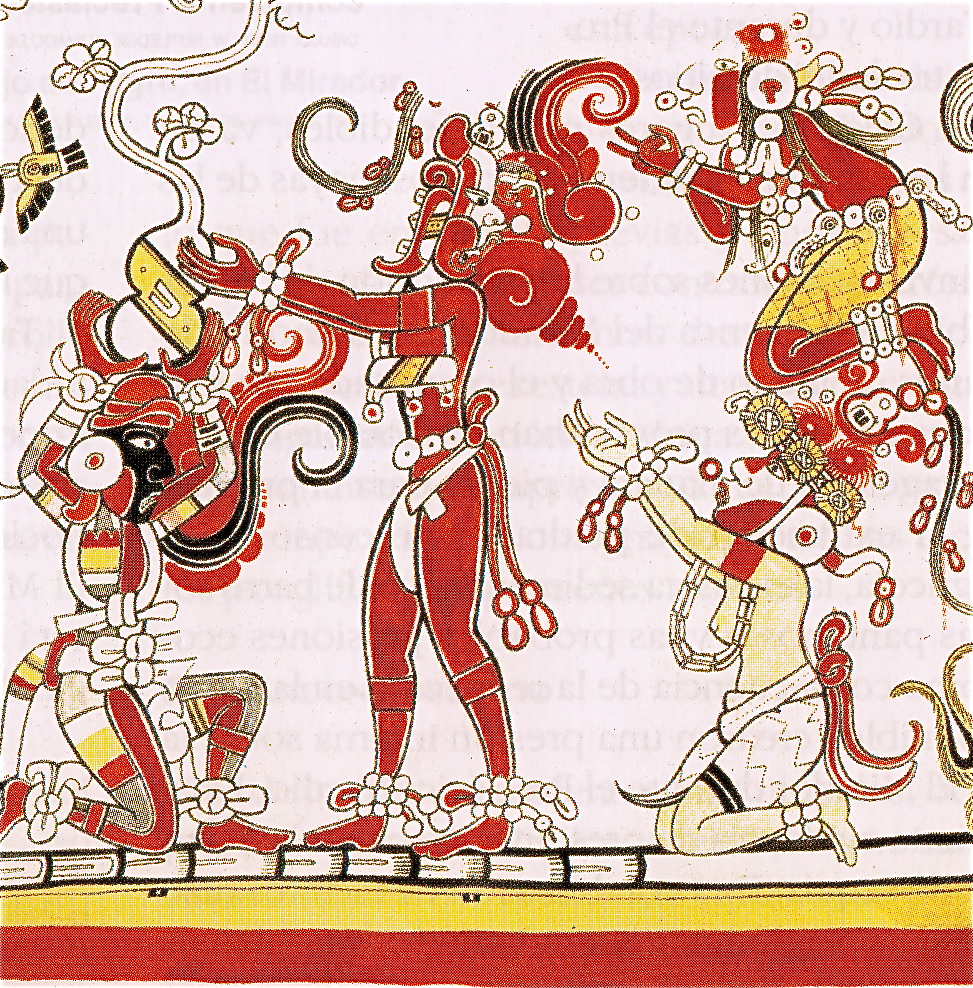
Maize God in Center of Scene

Woman Kneeling by Flower Mountain
implements in loincloths. They carry sacred objects for the Maize God and his wife. The final figure is an immense serpent whose body underlies the entire scene. Its tail emerges from Flower Mountain and its upturned head with open mouth emits large red speech scrolls. Black footprints along the red part of the snake’s body indicate it is a path for supernatural travel. The snake-as-ground motif is found widely in Mesoamerica. The Maize God is the central figure in the scene, personification of cycles of life, death and rebirth. The woman may be dressing him for his journey to death and resurrection. Red spirals coming from his mouth indicate breath and speech. Two short columns of glyphs between the bearers are ancient, hundreds of years earlier than most known Maya glyphs.
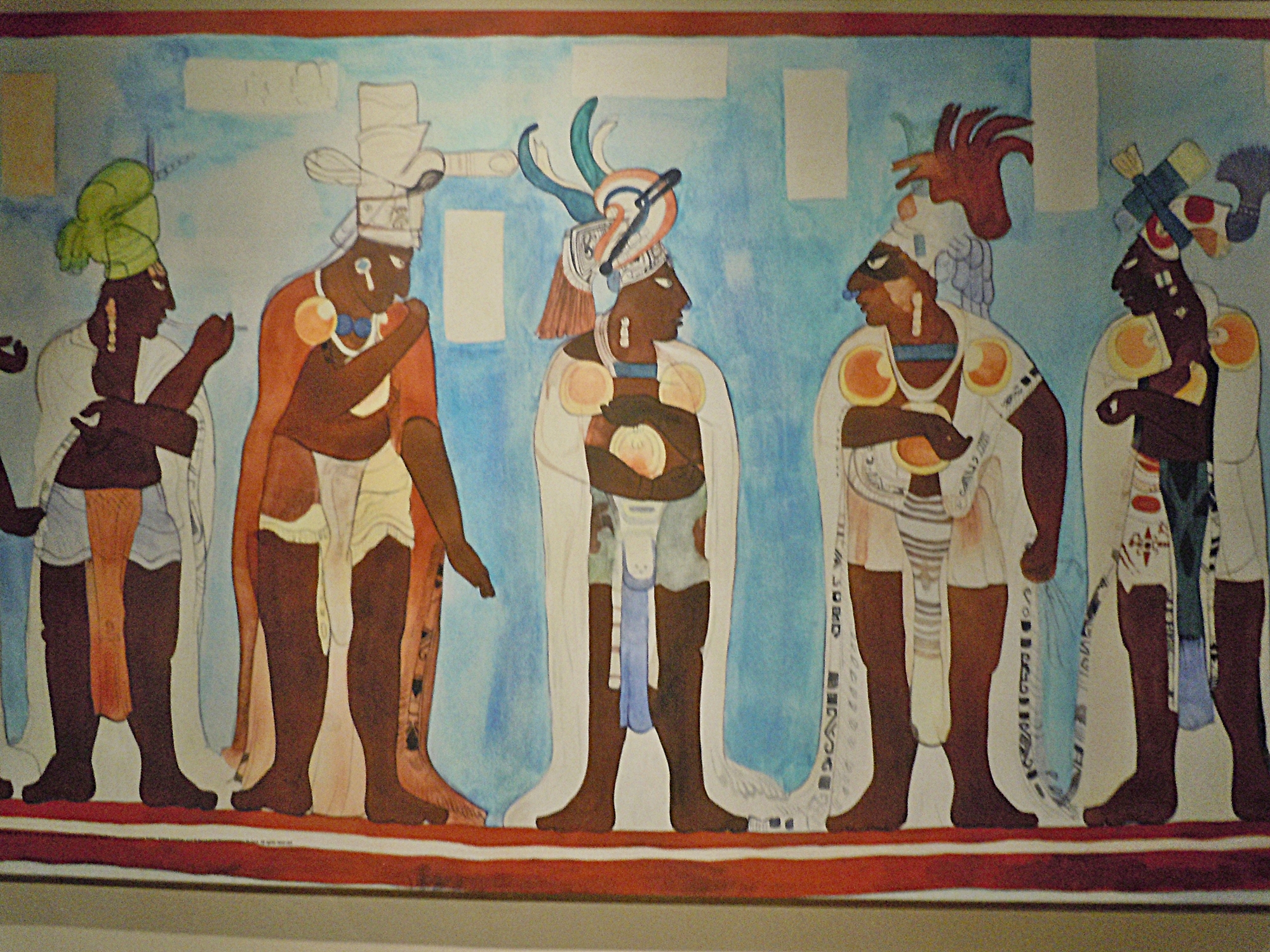
Murals at Bonampak Procession of Lords
The Murals at Bonampak, Chiapas, Mexico
The Bonampak murals are perhaps the best known of all Maya wall paintings. Lying close to a tributary of the Usumacinta River, it was first seen by non-Mayans in 1946, but it’s unclear who first visited the site. Two American travelers were led to the ruins by a local Lacandon Maya; his people still visited the site to pray in ancient temples. The site itself is unimpressive, but a small structure on a low hill holds the famous murals. Structure 1 at Bonampak, which holds the murals, was dedicated on November 11, 791 CE. Bonampak had become a satellite community of nearby Yaxchilán, whose ruler Itzamnaaj Bahlam II (Shield Jaguar) appointed his nephew Chan Muwaan II to govern the city in 790 CE. Shield Jaguar hired Yaxchilán artisans to construct the Temple of Murals.
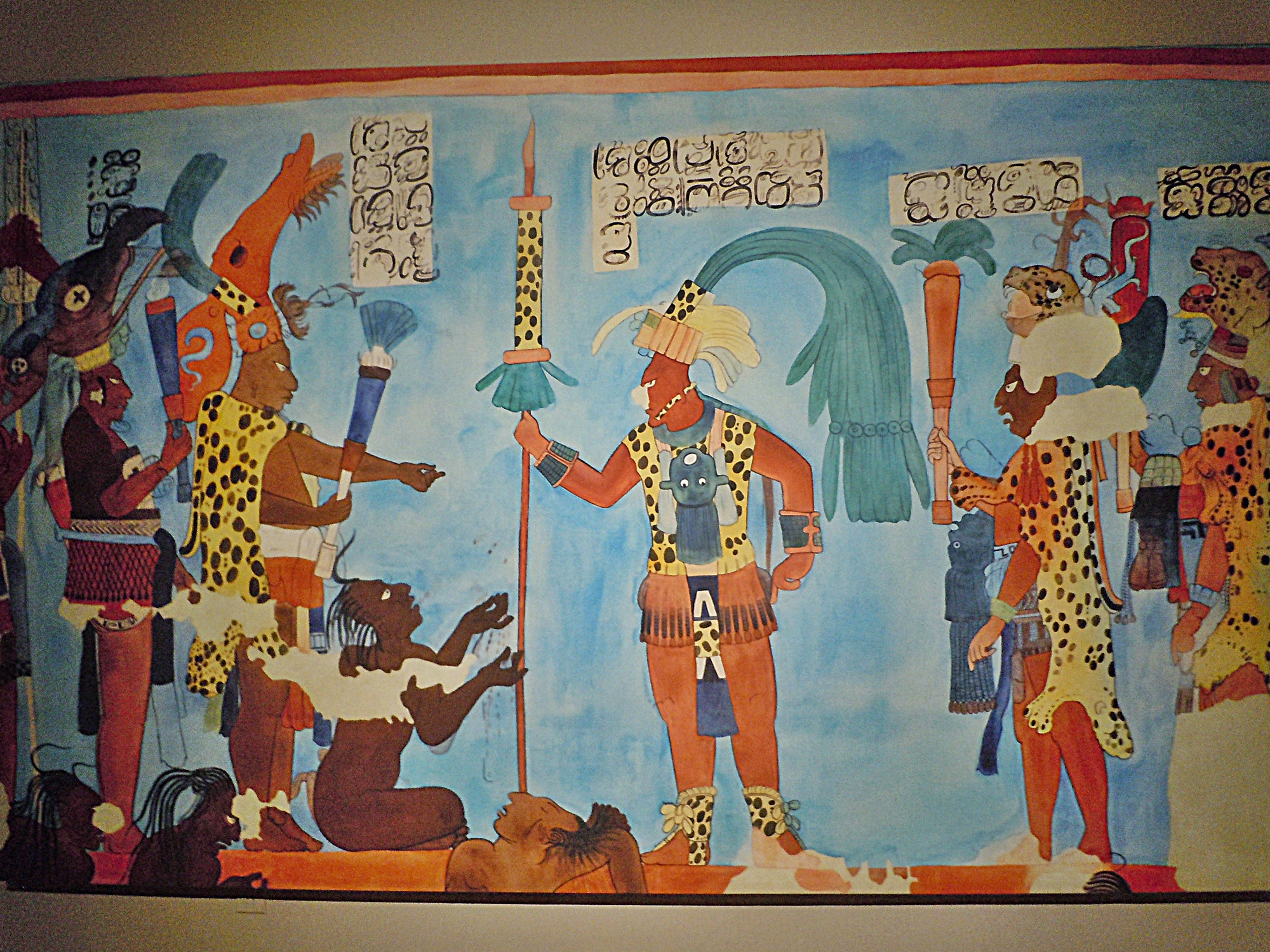
Murals at Bonampak
Ruler and Captives
Structure 1 has three rooms containing murals. The paintings show the story of a single battle and its victorious outcome. Among the best preserved Maya murals, these are noted for their vivid depiction of battle scenes, captive torture, sacrifice, and royal rituals and processions. They also depict women doing self-bloodletting by piercing tongues and earlobes with stingray spines. The battle scenes contradicted early assumptions that the Maya were a peaceful culture of mystics, a position long-held by influential Mesoamerican archaeologist, ethnohistorian and epigrapher from the Carnegie Institute of Washington, Sir John Eric Sidney Thompson.
Colors on the mural are intense and bright, although covered by a film of dissolved limestone when first discovered. Musical Instruments, costumes, body adornment, and weapons are documented from the

Murals at Bonampak
Women Performing Self-Bloodletting
period giving valuable information about Mayan culture. The vivid colored frescos of turquoise blues, yellows and rust colors are a treasure of data about royal life and ceremonies. Unfortunately the murals have deteriorated badly since their discovery. Early archeologists from the Carnegie Institution doused them in kerosene to remove the film and intensify the colors. This weakened the plaster, causing paint and plaster to flake and fall off.
Mary Miller of Yale University, who studied the murals extensively, wrote “Perhaps no single artifact from the ancient New World offers as complex a view of pre-Hispanic society as do the Bonampak paintings. No other work features so many Maya engaged in the life of the court and rendered in such great detail, making the Bonampak murals an unparalleled resource for understanding ancient society.”
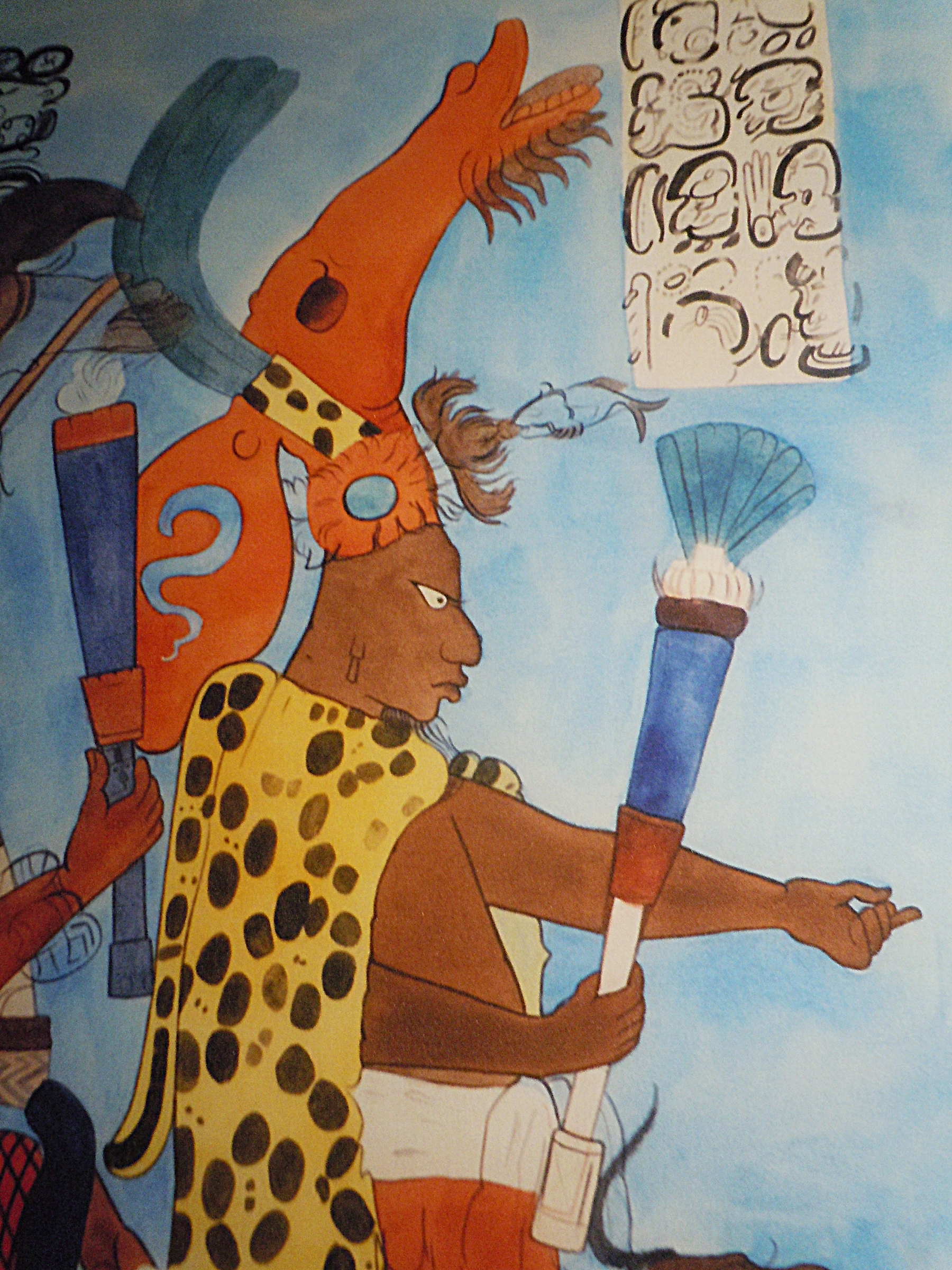
Murals at Bonampak
Maya Ruler

Murals at Bonampak
Lord Wearing Solar Disk
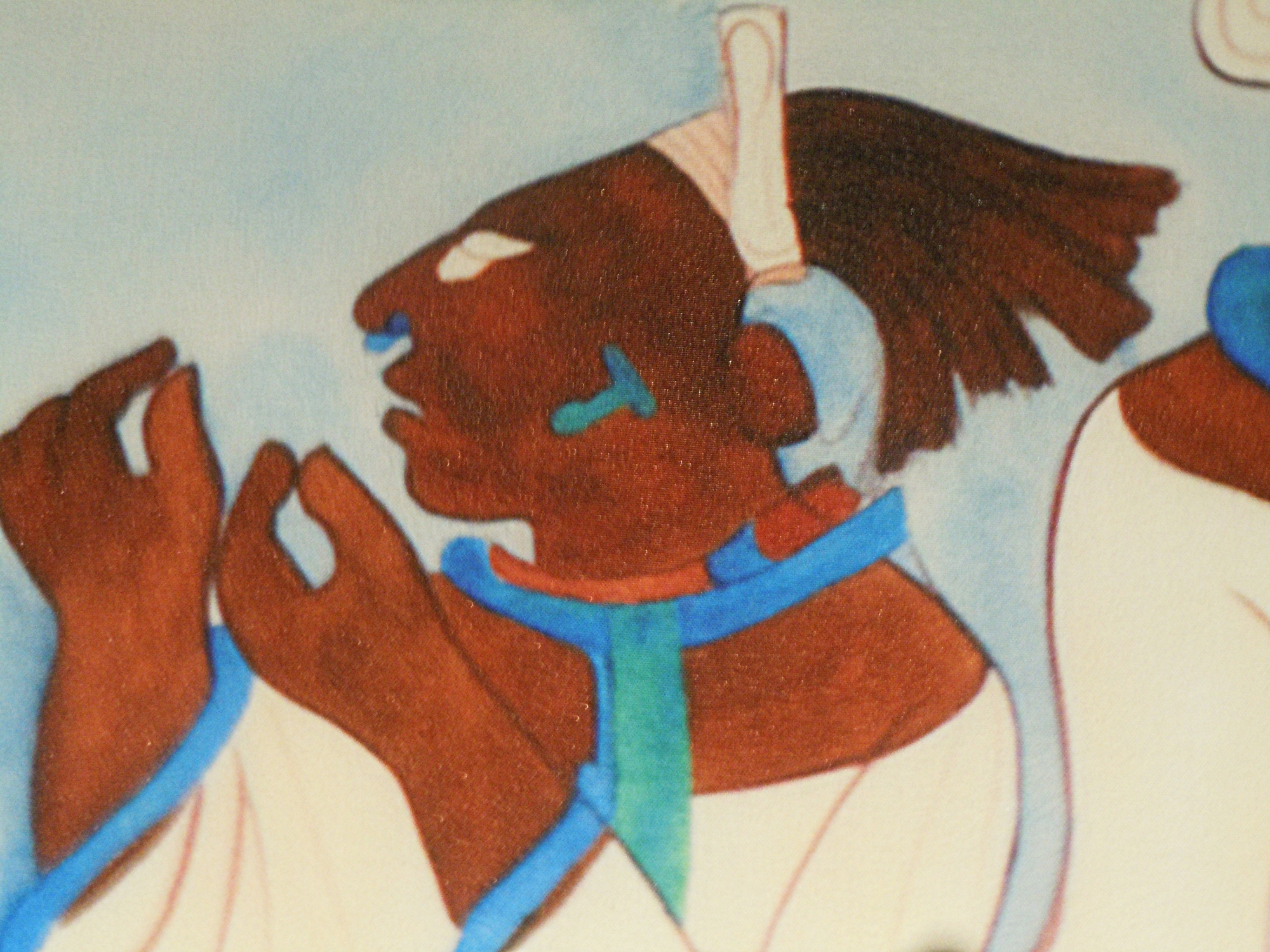
Murals at Bonampak
Royal Women
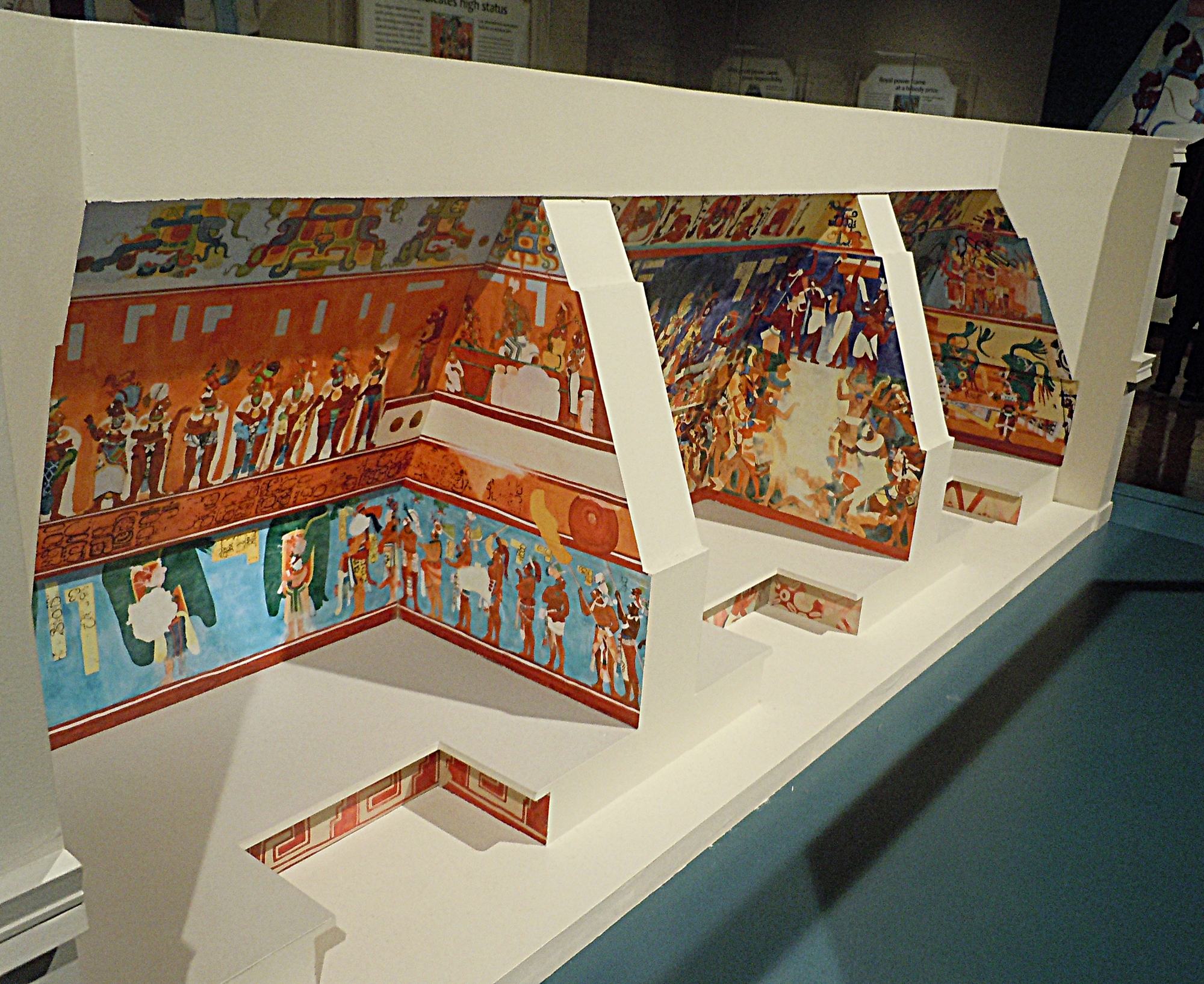
Cut-away Model of Three Chambers in Bonampak Murals
Monuments: A few large replicas of stelae, buildings, plazas and carved frescoes were on display.

Stela from Copan, Honduras
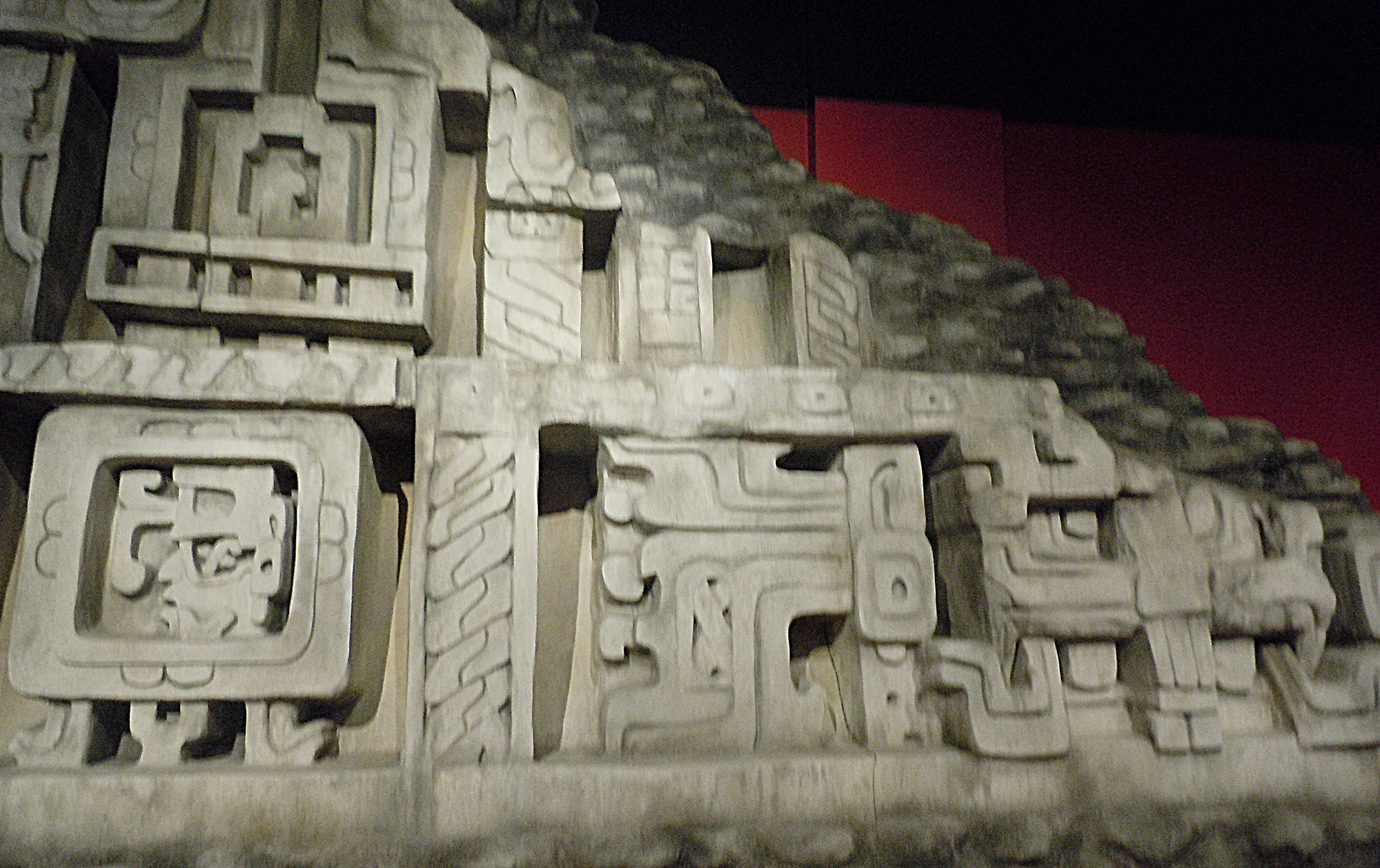
Carved Fresco on Pyramid in Xunantunich, Belize

Mask in Profile facing plaza
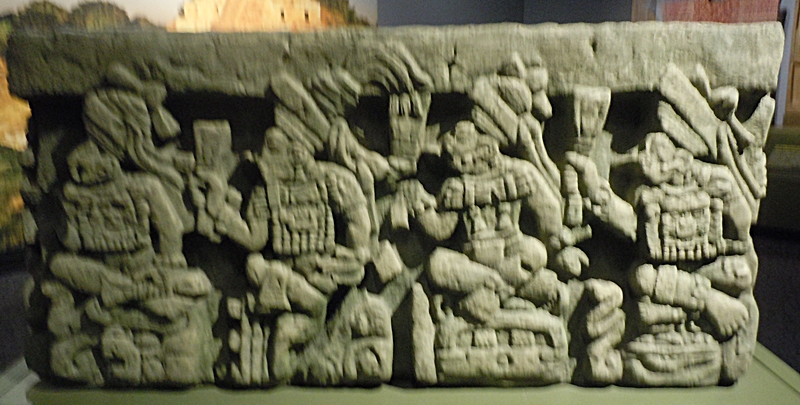
Carved Lineage of Rulers of Copan
Bench/Altar

Who Was the Mayan Red Queen? Part 2 – The Evidence of Her Life
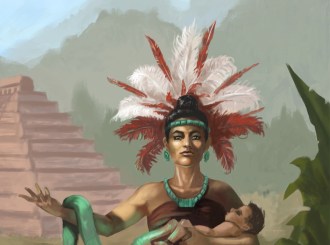 The Mayan Red Queen

continued to be an enigma to archaeologists for nearly two decades after her tomb was discovered in Temple XIII at Palenque in 1994. Her skeleton and inside of her sarcophagus were coated with red cinnabar, a mercuric oxide preservative used in royal burials. This led archaeologists to nickname her “The Red Queen.” It also made analysis of her bones and teeth difficult, and many years passed until scientific techniques advanced enough to provide reliable data. The lack of inscriptions and the sparse ceramic evidence found inside her tomb further muddied the waters. Most Mayan royal tombs contained carved or painted hieroglyphs identifying who was interred. The adjacent pyramid tomb of K’inich Janaab Pakal in Palenque was full of hieroglyphic records; his ancestors were carved on the sides of his sarcophagus, important gods and mythohistoric figures were painted on the crypt walls, and the sarcophagus lid clearly identified him. Numerous ceramic offerings allowed dating of the interment to the late 600s AD.
The situation of the Mayan Red Queen was quite different. Her sarcophagus contained no inscriptions, the crypt walls were bare, and ceramics few. The shape and characteristics of the censer, vases and plate found in her tomb corresponded to the Otolum ceramic complex, which has been placed between 600-700 AD. Her life overlapped with that of Pakal, and her pyramid tomb adjoined his, so it seemed evident that there was an important connection between them. Additional corollaries in their burials include a monolithic lidded sarcophagus inside a mortuary crypt, jade masks, diadems, jade beads, pearls and three small axes in a ceremonial belt. Both skeletons and insides of their sarcophagi were painted red with cinnabar. Two significant women in Pakal’s life died in that time period: his mother Sak K’uk and his wife, Tz’aakb’u Ahau. Some archaeologists believed the Red Queen was his mother; others favored his wife. In 2012 the mystery was most probably solved when DNA studies revealed that The Red Queen and Pakal did not share common DNA. This was further supported by strontium isotopes studies conducted a few years earlier showing that the two grew up in different areas within the region. Now most agree that Pakal’s wife, Tz’aakb’u Ahau, was interred in Temple XIII and she is The Mayan Red Queen.
What do we know of her life?

West Tablet from Temple of the Inscriptions
Linda Schele – Mesoweb
Unfortunately, very little evidence has been found so far. Palenque is famous for its high quality, graceful hieroglyphs and realistic carved figures. The Three Tablets of the Temple of the Inscriptions (Pakal’s burial pyramid) contain 617 glyphs, one of the longest Maya inscriptions known. The West Tablet, covering the later years of Pakal’s reign, contains two references to her:
“Seventeen days after the 3 Ahau 3 Uayeb (Period Ending), Lady Tz’aakb’u Ahau was married on 7 Caban 15 Pop.”
“Forty-seven years after she became queen, Lady Tz’aakb’u Ahau passed away on 5 Etznab 6 Kankin.”
These follow lengthy descriptions of actions taken by Pakal, and the dates are tied into the Long Count calendar by use of a Distance Number to the nearest Period Ending, which was 9.9.13.0.0 (3 Ahau 3 Uayab) or 626 AD. These later passages of the West Tablet were commissioned by their oldest son, K’inich Kan Bahlam II, after his father’s death. He recorded the marriage and deaths of his mother and father.
Tz’aakb’u Ahau is depicted in carvings on two tablets from Palenque. The Palace Tablet has carved relief figures showing her third son, K’inich Kan Joy Chitam II, seated on a double-headed serpent bar, receiving the headdress of royalty from his father Pakal, as his mother (Tz’aakb’u Ahau) offers him the god-figurine symbol of divine ancestry. This large tablet filled with rows of hieroglyphs originally adorned the rear wall of the Palace’s northern gallery, Houses A-D. The Dumbarton Oaks tablet shows a young K’inich Kan Joy Chitam II dancing in the guise of the rain god, flanked by his mother and father. This is the only surviving part of a larger composition that probably was surrounded by glyphs. The stone tablet was illicitly removed from an unknown temple in the mid-20th century; it now resides in Washington, DC.

The Palace Tablet
Pakal – Kan Joy Chitam – Tz’aakb’u Ahau
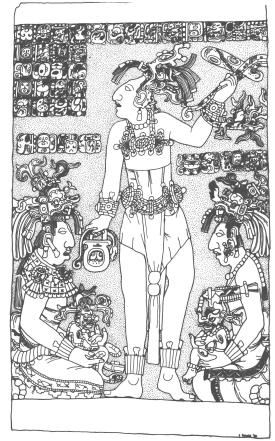
Dumbarton Oaks Tablet
Tz’aakb’u Ahau – Kan Joy Chitam – Pakal
Such fragments of evidence give a little knowledge of The Mayan Red Queen’s life: she came from a nearby city, married Pakal in 626 AD, bore him four sons, participated in accessions rituals symbolically after her death, and died in 672 AD, eleven years before Pakal’s death in 683 AD. She was buried regally in a smaller temple adjacent to Pakal’s.
Would you like to know more about what her life might have been? Her imagined story is told in my historical fiction book The Mayan Red Queen: Tz’aakb’u Ahau of Palenque.

Silver Medal Winner 2016 Global Ebook Award!
El Mirador Adventure
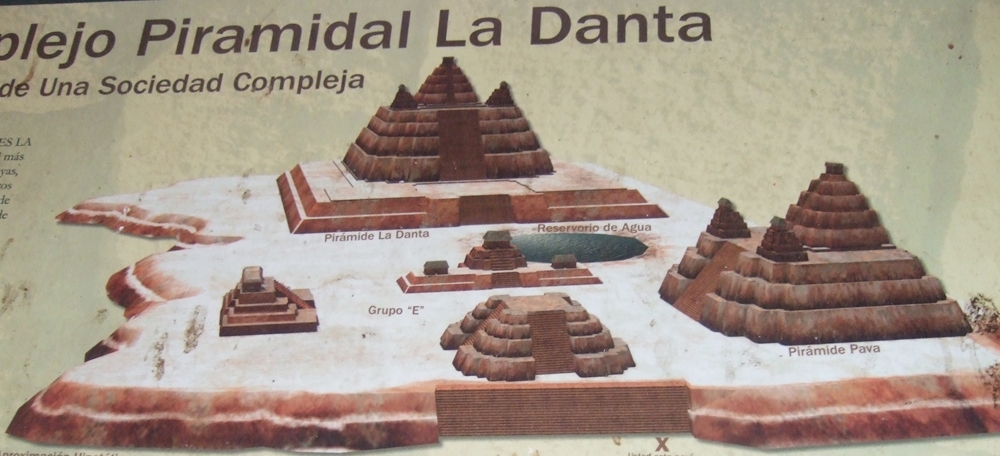
La Danta complex at El Mirador
Most Maya enthusiasts harbor the desire to visit El Mirador, a Pre-Classic site in northern Guatemala. Few ever do it, however, because getting there is arduous. El Mirador is located in the heart of a large swath of undisturbed low-lying jungle called the Mirador Basin in the Mirador-Río Azul National Park. This large tract of sub-tropical jungle is full of bajos or low wetlands with surrounding marshes, and no roads give access to its interior. The nearest town, Carmelita, sits at the end of a long dirt road. It takes three days of travel on narrow paths by foot or mule to reach the site, braving rains, mud, mosquitoes, snakes and jaguars. Most visitors come by helicopter, a thirty-minute flight from the town of Flores on Lake Petén Itza. This remote region is within the Maya Biosphere Reserve, 8100 square miles of protected rain forests designated by the Guatemalan government and supported by many groups to prevent deforestation, destruction and looting of ancient Maya sites.
Prudently, our group of ten intrepid Maya enthusiasts opted for helicopters over mule train. Led by Dr. Edwin Barnhart of the Maya Exploration Center, we flew over the rolling canopy of trees including

Helicopters landing in small clearing
ramón (breadnut), ceiba, mahogany, copal and sapodilla, some growing to 150 feet. Once beyond the reserve edge, cleared fields used for crops and cattle gave way to an unbroken sea of dense foliage, punctuated by what seemed to be hills, but were the tree-covered peaks of ancient pyramids. When we reached the tallest pyramids, whose stone tops protruded beyond the canopy, the helicopters circled for landings at the sites we were visiting: Nakbe, El Mirador and El Tintal. With military precision, the pilots hovered over small clearings nearly undetectable until you were right over them, and settled the helicopters down.
For most of us, this was the trip of a lifetime. All students of the ancient Mayas, we knew El Mirador was among the oldest Maya cities, possibly the largest, often called the “Cradle of Maya Civilization.” Although abandoned over 2000 years ago, there are tantalizing hints that the people of El Mirador may have migrated to the Caribbean coast then back inland to settle at Kalakmul, a powerful rival to Tikal in the sixth and seventh centuries. Mirador was known as the “Kan Kingdom” in the Pre-Classic, and the rulers of Kalakmul said they were Lords of Kan.
The Mirador Basin was home to numerous Pre-Classic Maya cities that might have supported a population close to a million people.(1) The oldest city, Nakbe, was likely occupied before 800 BCE, with clear evidence of occupation by 600 BCE. El Mirador, the largest city, flourished between 300 BCE and
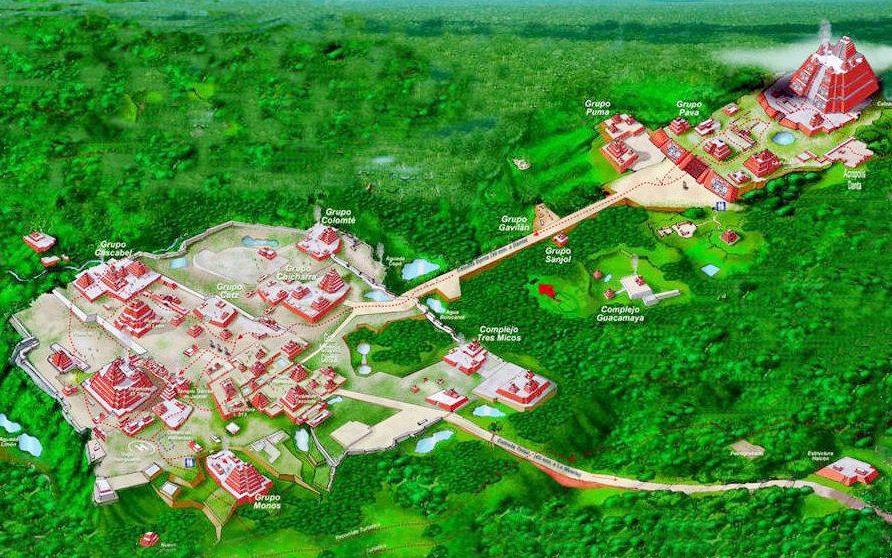
Map of El Mirador
150 CE with a peak population over 100,000. Its central area covers 10 square miles with several thousand structures, and its pyramids reach 180-230 feet high and include “La Danta,” among the largest pyramids in the world with its total volume of 99 million cubic feet. The second largest city, El Tintal, was occupied during this same time period. Its central area covers 3.5 square miles with nearly 1000 structures and several pyramids, the tallest 160 feet.
These three cities were linked by raised roadways called “sacbeob” built of stone and plaster, creating a network of white causeways through the jungle. Within each city, sacbeob led from one complex to another, providing a level walkway rising 18-20 feet above ground level and some 60-150 feet wide. The remnants of these causeways still provide level walking surfaces, now traversed by tree roots but cleared of brush by site workers.
The primary archeological work in Mirador Basin is conducted by Dr. Richard Hansen of Idaho State University. Beginning in 2003, his team initiated investigation, stabilization and conservation programs with a multi-disciplinary approach involving 52 universities and research institutes. The ruined city had been recorded and photographed in 1926-1930, but its remote and inaccessible location deterred much investigation, with Ian Graham making the first map in 1962 and Ray Matheny excavating the site center in the 1980s. The archeologists were surprised to find construction that was not contemporary with the
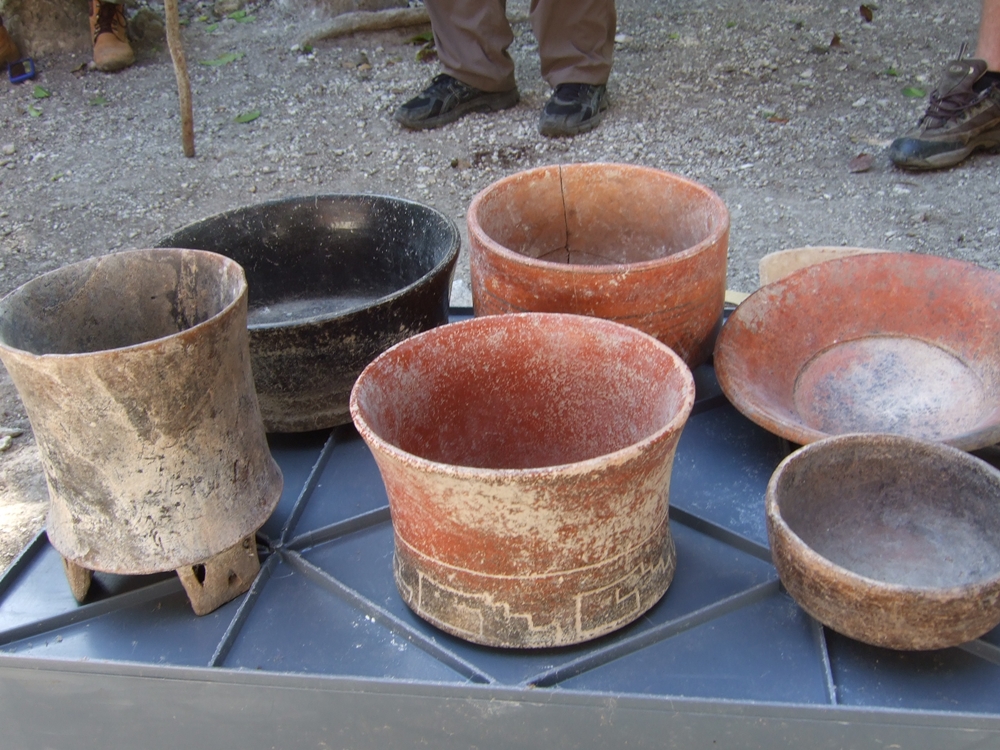
Pottery found at El Mirador
large Classic cities in the area, such as Tikal and Uaxactun, but from earlier centuries. Pottery fragments collected by Joyce Marcus in 1970 and others found by Richard Hansen in 1979 were identified as Chicanel style, a monochrome red, black or cream with turned-out rims and a waxy feel. This pottery had been dated to Late Pre-Classic (300 BCE – 150 CE).
Finding complex cities with immense platforms, tall pyramids and royal compounds that were dated to Pre-Classic times caused a shift in thinking about Maya civilization. The Mayas had a high culture and sophisticated social structure far earlier than was previously believed. Speculation about the source of Maya kingship systems that produced such monumental architecture include diffusion from Zoque-Olmec centers such as La Venta and Chiapa de Corzo, as well as cultural interaction with other Maya centers to the west. Multiple opportunities for cultural borrowing and lending raise the question of who borrowed what from whom.(2)
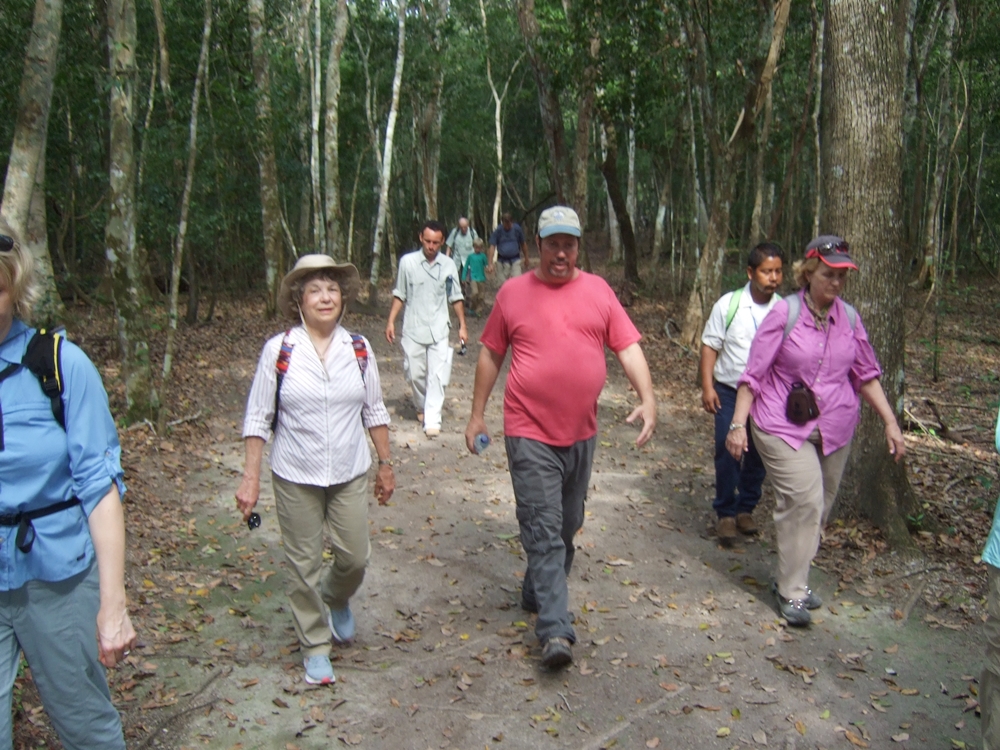
Walking on sacbe at El Mirador with archeologist Ed Barnhart (red shirt)

Sunset from top of El Tigre pyramid
As our group walked the wide tree-shrouded paths, we saw tall mounds of tumbling rocks rising through the foliage, and were amazed at the size and number of structures. Several complexes in El Mirador were partially cleared and restored, giving provocative views into this ancient culture that left no writing yet discovered. A central complex held several tall pyramids including El Tigre and its two flanking pyramids forming a triad group, with the Monos and Leon pyramids farther away. We climbed rickety stairs to the stony top of El Tigre and watched a spectacular tropical sunset. A five-mile round trip trek from our camp brought us to La Danta, gradually ascending over several levels of plazas covering nearly 45 acres. The platform supporting La Danta is 980 feet wide and 2000 feet long. Although the actual pyramid summit did not seem dauntingly tall once we arrived at its final platform, we kept remembering all the previous levels we had ascended. La Danta stands 230 feet, taller than Temple IV at Tikal. Though not as tall as the Great Pyramid of Khufu in Egypt, it is larger in volume at 99 million cubic feet.
Climbing switchback wooden stairs with handrails, we ascended to the top of La Danta and gazed across miles of jungle stretching 360 degrees to all horizons. A light wind cooled our over-heated bodies as we rested thankfully on large square stones. Two geodesic markers gave coordinates for the summit. In the distance the mounds of Nakbe and La Tintal were visible as forested hills. It was heady to be standing atop the reputed largest pyramid in the world. A sense of the expanse and inter-connectedness of the ancient Maya world created feelings of awe.

Stairs to La Danta platform
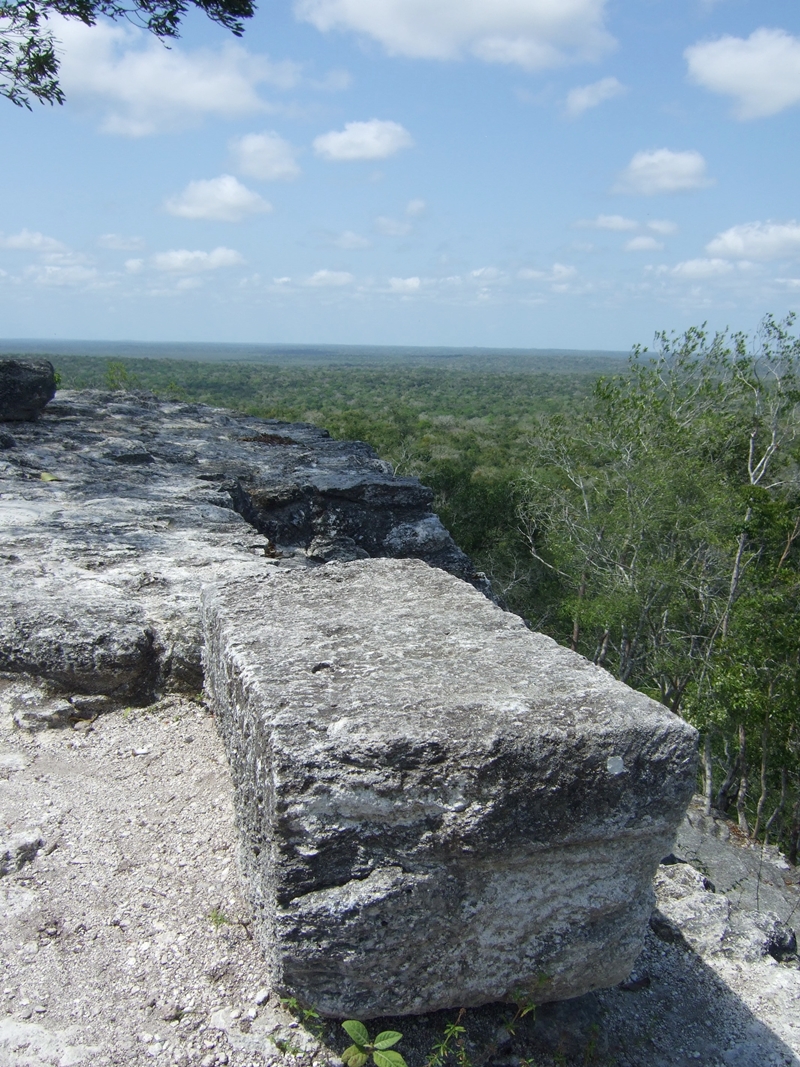
La Danta summit view across jungle

Standing on La Danta summit
The most important artwork found at El Mirador is the Central Acropolis frieze. In 2009 a student named J. Craig Argyle uncovered two 26-foot carved stucco panels that had been covered over by another structure. Their burial inside this structure, filled with dirt and crumbled stone, preserved this beautiful creation that depicts two young men in the “swimming god” posture. Above them are two bird figures, one a cormorant and the other a human-faced macaw. Richard Hansen believes the frieze relates Popol Vuh mythology, showing the Hero Twins, one wearing the jaguar headdress containing the head of his father. The Twins descended into Xibalba, the Underworld, to defeat the Death Lords and resurrect their father (Hun Hunahpu, First Father of the Mayas). The cormorant signifies rulership lineages and links to Great Mother Goddess Muwaan Mat (Duck-Hawk/Cormorant). The human-faced macaw represents the False Pole Star Wuqub Kaquix, an arrogant macaw who tried to become a god. The Hero Twins shot him from a tree with their blow-gun, unseating his lordship.(3)

Central Acropolis Frieze
Composite View
Finding this depiction of the Popol Vuh myth in a Pre-Classic site proves that the story has great antiquity and predates contact with Spanish Christianity by thousands of years. Contact-era renditions of the Popol Vuh were thought to be influenced by Christian imagery. Ed Barnhart questions whether the frieze actually depicts the Popol Vuh, because key elements that signify the Hero Twins, such as jaguar spots and catfish barbels, are missing. However, we know the Popol Vuh was well-established early in Maya mythology from murals discovered in San Bartolo, Guatemala, dated to 100 CE that also portray scenes from this story.(4)
Tent camp rigors
To see these fantastic carvings and other artifacts, to climb the pyramids that soared above the jungle canopy, to walk the pathways trod by ancient Mayan feet in times long past, required commitment and dedication. Conditions in our tent camp in El Mirador were primitive, without electricity or running water, and without showers. Our guide Ed Barnhart arranged for everything we needed to be brought by

Ocellated turkey
mule train, a 5-hour trek along a jungle path from Carmelita. The mules packed in all our drinking and cooking water, food, drinks, tents, bedding and implements. A staff of two cooks, two local guides, and four carriers attended us. Our meals were surprisingly good, cooked over fires in primitive conditions. The Mayan woman cook made delicious traditional tortillas and provided meals of rice, chicken, vegetables, black beans, eggs, pancakes, fruit and cereal. We drank from water bottles, using iodine to purify the larger water tanks when we ran out of bottles. Refreshing limeade accompanied meals; at

Camp hand washing station
times we resorted to luke-warm gatorade when the ice melted. A hand washing station with suspended dishrag and soap dispenser served well; we had several tarp-enclosed outhouses and a tarp-covered picnic table. In our tent area, three hammocks suspended from trees offered afternoon respite.

Hammocks and tent camp
Unseasonal rains occurred before we arrived, so the first day was fresh and less hot. Hot is the operative word; the next several days were roasting and muggy. Everyone got very sweaty, especially as we wore long sleeve shirts and long pants with closed shoes to prevent bites. There were far fewer bugs than expected; our guides said “three mosquitoes per person” but an abundance of spiders, gnats, moths, ants, and crickets. Very large, black cicadas serenaded us dusk and dawn, making an ear-splitting high whine. A flock of ocellated turkeys hung around camp, their iridescent feathers shining. The male’s deep popping noises started at 4:00 am, along with the roars of howler monkeys that are often mistaken for jaguars, which actually make grunting noises. Though some folks were concerned about the deadly fer-de-lance snake (called yellow jaw) our guides said rattlesnakes are much more common. The only snake we saw was a small dead one, possibly a fer-de-lance.
Sleeping in tents on air or foam mattresses was far from comfortable, especially the last two nights that were oppressively hot. A generator provided light until 9:00 pm at the kitchen and meal area, and around our tent camp hammocks. Trips to the outhouse required using flashlights and keeping an eye out for snakes and bugs. We were up at dawn, thanks to the turkey and howlers, and eager for our first

About to climb Nakbe pyramid
cup of coffee – surprisingly good instant called “Inka-mundo.” Taking advantage of the morning for our first excursion, we hit the sacbeob early and were out around 2-3 hours, using lots of energy walking and climbing. We’d return for lunch and a siesta, then make another trip to the site late afternoon. At Nakbe and El Tintal, we spent about 2 hours while the helicopters waited. Upon returning to Flores, the first thing everyone did was take a long shower, do some email or texting, then get a cold margarita or beer!

Back in Flores enjoying margaritas
Our group of adventurous souls was uncomplaining about creature discomforts and deeply appreciative of this great opportunity to visit a remote Maya site of vast significance. The impressive size and number of cities with their monumental and residential structures, located in a nutrient-rich swampy region, led our imaginations to picture the area at its height: people streaming along wide sacbeob, using sophisticated techniques to quarry huge limestone blocks without metal tools, move them to building sites without wheels and lift them to amazing heights, interacting in complex class societies with a cohesive ideology, performing splendid rituals, producing striking carved art and ceramics, collecting rainwater in cisterns, using body decoration such as inlaid jade in teeth and skull shaping, and using imported objects such as seashells, obsidian and basalt.
Between 100-200 CE, the cities of Mirador Basin were abandoned. The people apparently left quickly, leaving ceramics and working tools where they were used. Hansen believes the exodus was caused by destruction of the swamps that supported their agriculture. Massive deforestation in surrounding areas to provide wood for making lime plaster may be the underlying cause. In El Mirador they plastered everything from temples and plazas to sacbeob and house floors, making the plaster thicker over time. The reason, says Hansen, was “conspicuous consumption” by elites trying to sustain an image of wealth and progress. Clay drained from forests into the swamps and covered the rich soil. A portion of El Mirador was temporarily re-occupied in the Late Classic, around 700-900 CE, with small structures built among the ruins. Here the occupants, probably scribes
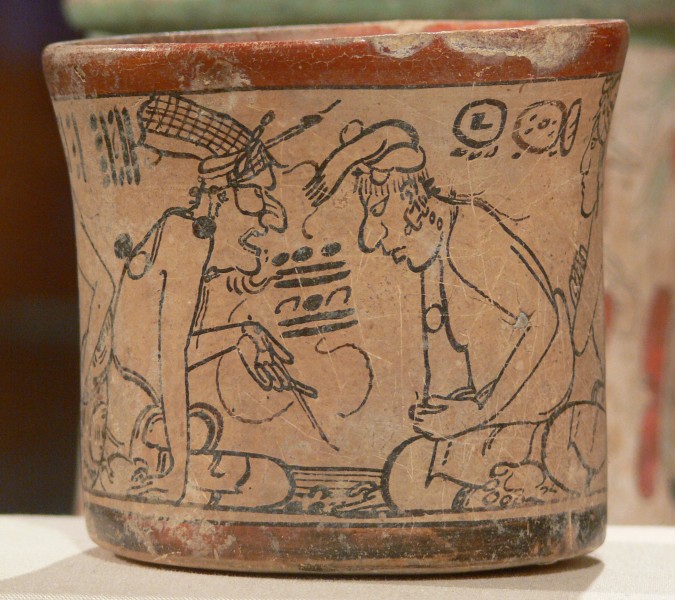
Maya Codex style ceramic
and artists from Kalakmul, produced unique “Codex-style” ceramics, fine polychrome ceramic consisting of black line drawings on a cream colored background. This was beyond doubt the trip of a lifetime. It was not easy, but it was rich in learning and experiencing

Ed Barnahrt and Lennie Martin, La Danta summit
the residuals of a once-great culture that flourished then declined, leaving many unanswered questions. For Maya enthusiasts, it stimulates further research into the mysteries of the Pre-Classic, seeking to understand how kingship structures and class societies came into being, the power and trade relationships among sites, the stories of the residents and their lives.
References
- Chip Brown. El Mirador, the Lost City of the Maya. Smithsonian Magazine, May 2011.
- John E. Clark and Richard D. Hansen. The Architecture of Early Kingship: Comparative Perspectives on the Origins of the Maya Royal Court. Royal Courts of the Ancient Maya, Vol. 2. Edited by Takeshi Inomata and Stephen D. Houston. Westview Press, Boulder, CO, 2001.
- Dennis Tedlock. Popol Vuh. Touchstone Book, Simon & Schuster, New York, 1996.
- William A. Saturno, David Stuart, Boris Beltrán. Early Maya Writing at San Bartolo, Guatemala. Sciencexpress Report, January 5, 2006.
Leonide (Lennie) Martin writes historical fiction about ancient Mayan civilization. Visit website at Mists of Palenque.
Maya Elder Visits U.S.
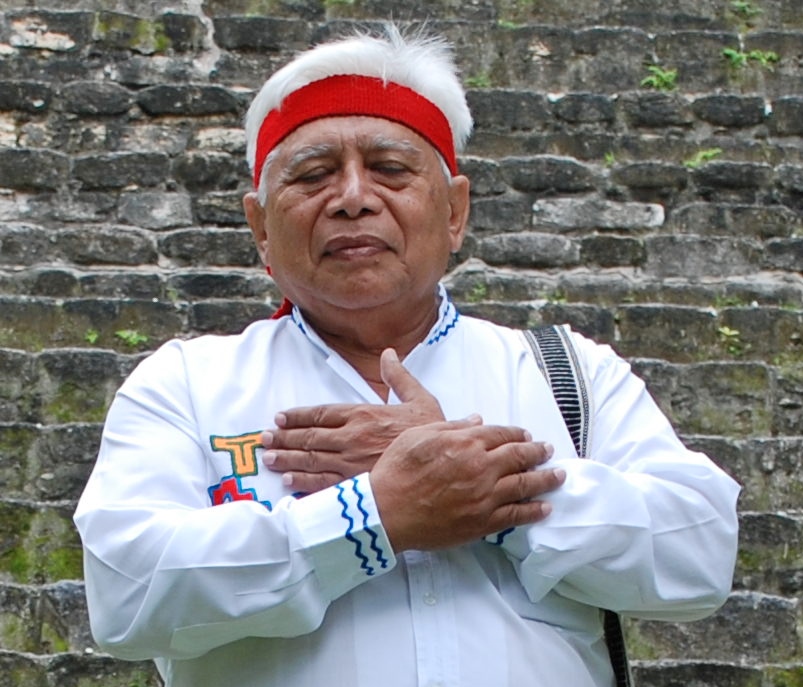
Itza Maya Elder, Shaman and Daykeeper Hunbatz Men
Hunbatz Men, Itza Maya Elder, Shaman and Daykeeper teaches about ancient Mayan civilization and calendars
Member of the Council of Priests and Elders in Yucatan, Mexico, Hunbatz Men is an authority on the history, cosmology, sacred geometry, calendars and language of Mayan civilization. He founded the Maya Cultural Center at Lol Be near Chichen Itza, and serves as spiritual guide for several Maya Mystery Schools in the U.S., Europe, Japan, South Africa and Australia. Elder Hunbatz is among the first indigenous Maya leaders to teach their esoteric knowledge to the public. He has conducted conferences and pilgrimages to sacred Maya sites for over 35 years, and travels internationally giving classes. He presented the Mayas’ request for peace and nature stewardship before the United Nations in 2010 with other elders. Author of numerous booklets and papers, Elder Hunbatz wrote two seminal books on Maya sciences, religion and calendars, and developed a system of Maya Yok’hah (yoga practices of ancient Mayas).
Programs in Portland, OR on July 24 and 26, 2014
Hunbatz Men is teaching two programs at New Renaissance Bookstore in Portland OR:

Mayan glyphs and codes in the Dresden Codex
Mystic Codes in Mayan Language, Friday July 25, 7:00-8:30pm – $15 Mayan language contains mystic codes. The vibratory sounds of Mayan words have the power to activate energy and manifest, like Sanskrit bija sounds. These sounds come from nature and natural laws; the sounds of the cosmos. Sacred sounds, hand gestures and postures are part of Mayan language. Experience their power to transform consciousness and uncover hidden Maya wisdom.
Hidden Messages in Codes of Mayan Glyphs, Saturday July 26, 1:00-5:00pm – $50 Mayan glyphs, carved on stone monuments and painted on ceramics and in codices, contain hidden messages encoding cosmologic laws. To understand these messages, you must attune to Mayan consciousness. In this workshop Hunbatz Men uses a real Maya Codex to reveal mystic codes that can take you into higher dimensions of Maya wisdom. You will explore the meanings and symbols in this mysterious Maya Codex, gain insight into use of rituals to expand consciousness, and learn how Mayan language and glyphs are used for transformation.
Unique opportunity to study with internationally known
indigenous Maya Elder-Shaman-Daykeeper at his first Portland event!

Hunbatz Men discussing ancient Maya codex
My Connections with Hunbatz Men

Elder Hunbatz Men and Leonide (Lennie) Martin, Maya Ceremonial Center at Lol Be, Yucatan, MX
I met Elder Hunbatz in 2001 when on a pilgrimage at Chichen Itza led by leaders of indigenous groups from many countries. After reading his first book, Secrets of Mayan Science/Religion, I realized he was the Maya teacher I’d been seeking. When I moved to Merida, capitol city of Yucatan in 2005, I started my study and apprenticeship with him. Through him I became a Maya Solar Initiate, and later took training as a Maya Fire Woman. During my 5 years living in Merida, I assisted Hunbatz in many programs and pilgrimages, and helped develop and write the workbook for Yok’hah Maya. Through studying the Maya calendars with him, I began to understand their incredibly advanced and complex approach to time and cycles. The integrated and holistic world view of the Mayas, and their message about living in harmony with cycles of nature and the cosmos, have continued to inspire and instruct me.
The Maya way of thinking and seeing the world is very different than western materialism. Its mystical understanding of reality as spanning multiple dimensions is similar to principles of quantum physics. Many times it was difficult for me to truly grasp

Leonide (Lennie) Martin and Hunbatz Men do ceremony at Lol Be
Hunbatz’ teachings, but when understanding dawned it left me quite astonished. There is such depth in this ancient wisdom, so much intelligence in the unfolding of cosmic patterns that the Mayas knew were reflected on Earth. It has been a great honor and privilege to learn from and work with Elder Hunbatz. I invite everyone to dip into this vast pool of knowledge that expands consciousness and leads to transformation.
In Lak’ech (I am another you),
Lennie

Lennie with Maya elders at Chichen Itza
 leonidemartinblog