
Home » 2020
Yearly Archives: 2020
Adena and Hopewell: Advanced Indigenous Cultures of North America
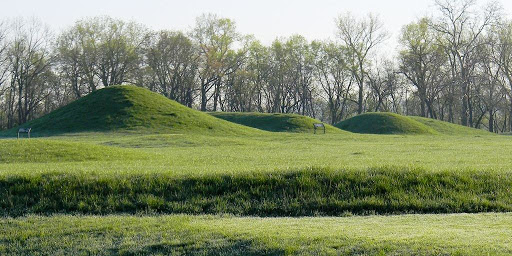
Hopewell Ceremonial Earthworks – World Heritage Ohio
Honoring Native American Heritage Day — Indigenous Mound-Pyramid Builders the Adena and Hopewell Cultures
Today, November 27, 2020 is Native American Heritage Day in the United States. It’s the day after Thanksgiving and offers a different perspective on the indigenous peoples living across the northern continent. Contrary to popular colonial myth, the continent was widely settled far in advance of the Pilgrim’s arrival in 1620, and the southeastern cultures were particularly advanced hundreds of years earlier. The Adena and Hopewell civilizations lasting from 800 BCE to 500 CE were the first to build large cities and impressive earthworks in areas spanning the current states of Ohio, Kentucky, Indiana, and West Virginia. We do not know the names these indigenous peoples called themselves; Adena and Hopewell were given to them later based on local settlements in their regions.
At the same time as the height of Roman Empire (100-476 CE), there were thriving civilizations in North America. The extent of their trade network spans the eastern half of the United States, rivaling that of the Roman Empire. Massive earthwork enclosures built by these peoples are the largest collection on the planet, yet their construction still a mystery.
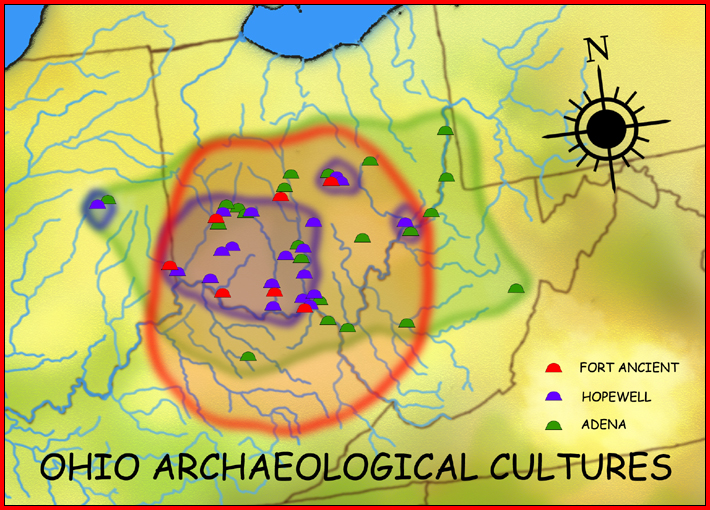
Map of Adena and Hopewell cultures. Wikimedia Commons, H. Rowe, 2008
Adena. Existing for about 900-1000 years, the Adena began mound building in central and southern Ohio regions. This evolved from prior practice of burying dead in piles of shells alongside rivers, including pet dogs, then moving to burials in large mounds of earth along with funerary objects such as jewelry, art, and ceramics. The Adena were notable for an extensive trading network which supplied them with copper from the Great Lakes to shells from the Gulf Coast. They developed agricultural practices, pottery, and artistic works although still living semi-nomadic lives and relying on hunting and gathering. Some Adena mounds—actually pyramids—were very tall and conical in shape, the highest being 65 feet tall at Miamisburg, Ohio. These pyramids were smooth on top and capped with clay, beginning as mortuary buildings which were ceremonially burned, then layers of burials placed on top followed by a new mortuary structure, and the process kept repeating.
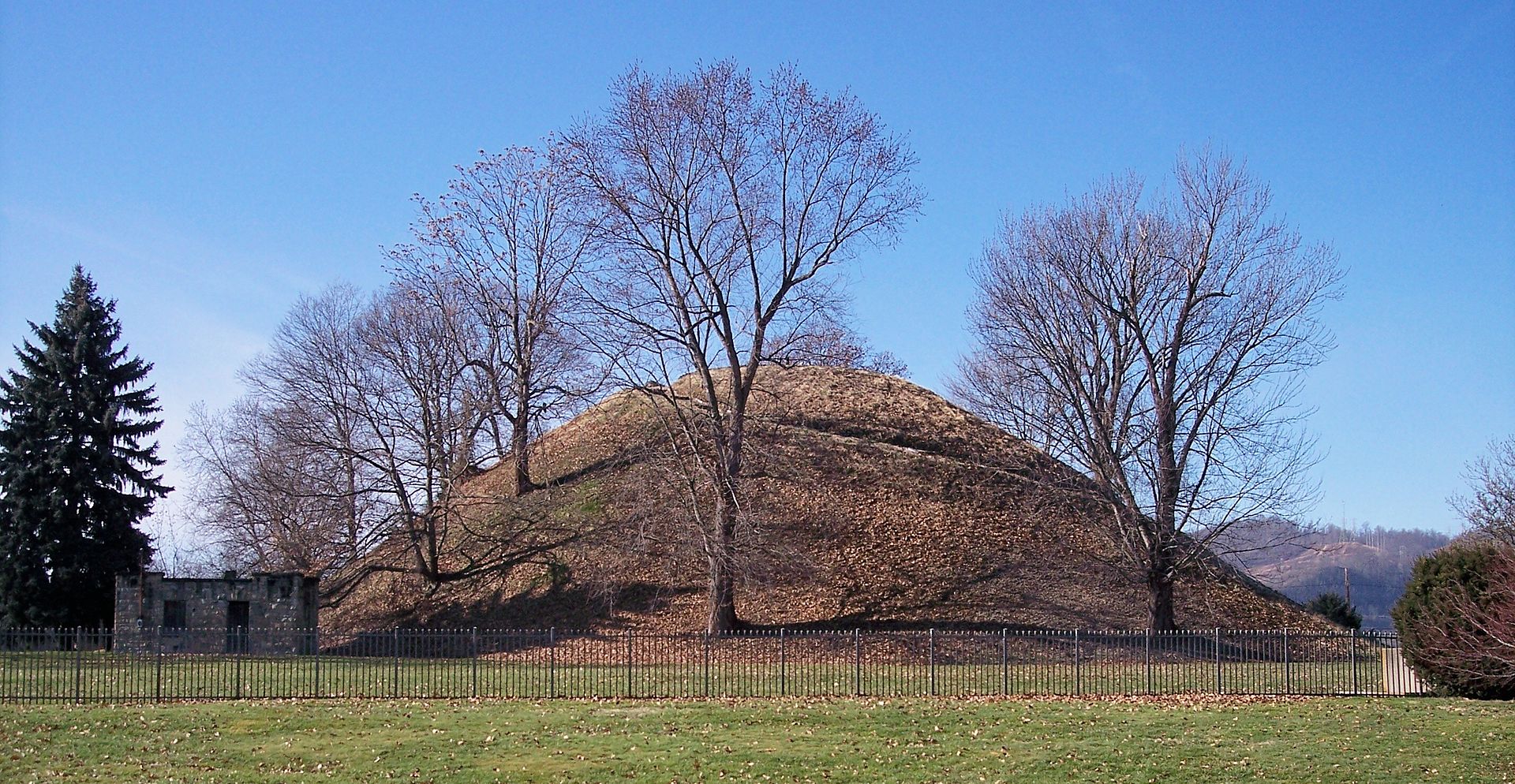
Grave Creek Mound, Adena Culture in Moundsville, West Virginia
62 feet tall, 240 feet diameter Wikimedia Commons, T. Kiser 2006
Adena people lived in small settlements of one to two structures; houses typically built in a circle ranging from 15 to 45 feet diameter. Walls were made of paired posts tilted outward, joined to other wood pieces to form a cone shaped roof covered with bark. The Adena had stone tools and axes, bone and antler tools, spoons and other implements. A few copper axes were found, but metal was generally hammered into jewelry such as bracelets, rings, and pendants.
Hopewell. Descendants of the Adena, Hopewell culture epicenter was Ohio starting at 100 BCE and lasting until 500 CE. Hopewell were masters of land survey and geometry, continuing the Adena custom of earthworks and mound-pyramids but vastly enlarging it. They extended the trade network from the Crystal River Indian Mounds in Florida to the northern shores of Lake Ontario, the Gulf Coast, and from the Mississippi River far to the east, but did not have much influence on the East Coast. From these regions they obtained mica, copper, shell, and soapstone. They produced beautiful artwork and made stone pipes in shapes of effigy animals, smoking tobacco and perhaps other substances.

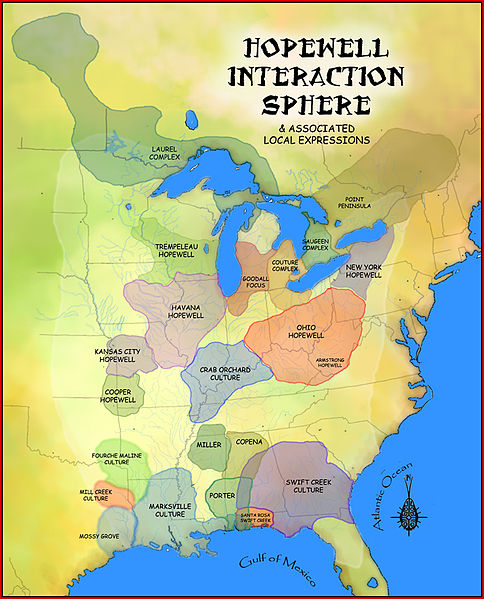
Hopewell Interaction Sphere
Wikimedia Commons, H. Rowe, 2010
The name Hopewell came from mounds excavated in 1891-92 by Warren Moorehead at the property of Mordecai Hopewell in Ross County, Ohio. The Hopewell built earthworks in clusters of 10-20 mounds or more in same area. Once there were tens of thousands, but Hopewell mounds now only number in the hundreds due to encroaching development, both farmlands and towns. Many remaining earthworks are now preserved in parks and historic sites.
The great Hopewell geometric earthworks are among the most impressive indigenous monuments in the U.S. They take various geometric shapes and rise to amazing heights, often shaped like animals, birds, or serpents. There are gigantic enclosures bounded by berms of earth that are 20 feet wide by 20 feet tall. These often covered 20 acres (15 football fields); and could hold 17 pyramids of Giza inside. Some reached 50 acres and the largest is 111 acres at the Hopewell site. Maps and drawings made in the 1840s document earthworks, many that are now destroyed, but some have been preserved at the Hopewell Cultural Historic Park.

Model of Hopewell Ceremonial Earthworks, Newark
World Heritage Ohio
Mystery of Massive Earthworks. An impressive level of coordination was needed to build all these earthworks, spread over a large region and using the same geometric principles and formulas. One repeated measurement is 1053 feet, appearing in different parts of structures—some square, rectangular, octagon. Many areas have enclosures of 20 acres, and squaring the circle or circling the square was used repeatedly. Hopewell structures were built so measurements of a square fit inside a circle and vice versa. Such repetition shows that there was clear intentionality in building. But who organized the labor forces to build massive geometric earthworks?
Hopewell villages were small and the people did not live near the earthworks. Villages were a few miles away, rarely had more than 100 people, houses were simple rectangular (occasionally circular) shapes made of wattle-and-daub with grass roofs, holding 1-2 families. Diet was simple, with small scale agriculture augmented by hunting and fishing. They did not have corn, cultivating native plants like pigweed, sunflowers, maygrass, and goosefoot. These were egalitarian settlements without large differences between houses denoting different social status. There is no evidence of a chief or ruling class. There was some class differentiation seen in burial placements inside mounds and amount/types of burial artifacts. The largest burial mound is at the Hopewell site, three interconnected structures 500×180 feet, and 30 feet tall at the base. Following Adena practices, these mounds started as mortuary structures, then were burned and burials put on top, taking place over years and decades. The most elaborate burials were in the center, the earliest phases. Multiple burials were interred at once; bodies must have been stored for a while before being interred. Group burials were not due to war and there is no evidence of violence or warfare in Hopewell archeology. Burial pyramids grew in size over time, then were capped with hard surface and temples built on top.
Hundreds of workers were needed, along with persuasive leaders to accomplish these works, but archeological evidence shows only small egalitarian villages. According to archeologist Edwin Barnhart‘s theory, these small, peaceful villages banded together to create the earthworks, probably as gathering places for celestial timed ceremonies. Building the earthworks in itself was the ceremonial event. They gathered together every decade or two, timed to lunar events, as a single people to create something great and enduring. Such shared effort in raising monuments is powerful builder of community. (ArchaeoEd Podcast Episode 3 – The Hopewell)

Model of Hopewell Earthworks at Fort Ancient, Ohio
World Heritage Ohio
Astronomical Aspects of Hopewell Earthworks. Hopewell earthworks encode knowledge of astronomy focusing on solar system objects; known as “horizon based astronomy.” This takes note of the rise and set of the sun, moon, and planets, all visible to the naked eye. The Hopewell made solar and lunar observations, and several earthworks align to winter or summer solstice: Hopeton, Dunlap, Anderson, Mound City, and Hopewell site all have solar alignments through diagonals, not sides of the squares. At times they had to make adjustments for mountains; the Marietta site has mountain ridges so they used astronomical knowledge and land survey techniques to compensate in aligning with solstice.
Octagon sites at Newark and High Bank did not have solstice alignments, but instead followed movements of the moon. The many angles of the Newark octagon captured all lunar alignments. Lunar maximums (maximum excursion along the horizon) occur every 18.6 years at full moon. This moon cycle of lunar maximums and minimums was captured by Hopewell. It takes years to determine this; there are 4 such alignments in a full cycle, 2 maximum and 2 minimum. Different lunar alignments were used at the High Bank site octagon.
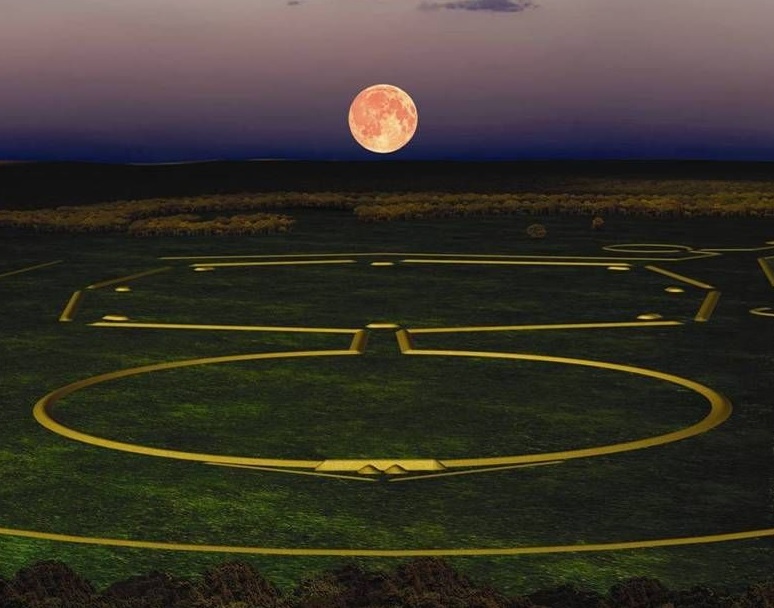
Lunar rise above octagon-circle earthworks, Hopewell site, Ohio
World Heritage Ohio
Lunar Aligned Earthworks at Newark Ohio. This spectacular lunar alignment at the Hopewell site in Newark, Ohio (built between 100 BCE – 300 CE) includes the 1200-foot-diameter Great Circle with its steep inner ditch and monumental framed gateway, plus the Octagon Earthworks, forming a perfect circle and adjoining octagon over a half-mile across. The perfectly formed, eye-level embankments align with all eight of the key rise- and set-points of the moon during its 18.6-year cycle, within a smaller margin of error than that at Stonehenge. World Heritage Ohio.
Cultural decline: Around 500 CE, the Hopewell stopped building mounds and earthworks, their trade exchange ended, and their art was no longer produced. Rising hostility is a possible cause, since villages at the end of the Hopewell period became larger communities that built defensive walls and ditches. Climate change with colder conditions probably drove game animals north or west, and had detrimental effects on plants, drastically reducing these food sources. The bow and arrow were introduced during this time, improving hunts but further depleting game. This effective weapon made warfare more deadly, driving people into larger fortified communities. With fewer people using trade routes, the network linking people to the Hopewell traditions diminished. Full-scale agriculture after introduction of corn might also have contributed to breakdown of social organization. Conclusive reasons for the dispersal of these prodigiously creative people have not yet been determined. (Wikipedia, Hopewell Tradition)
Pyramid Builders of North America

In the eastern parts of the United States, where the states of Illinois, Kentucky, Ohio, Mississippi, and Louisiana are now located, a large and advanced indigenous culture left their lasting legacy through impressive earthworks, commonly called “mounds.” Usually referred to as the Mound Builders, these structures actually are earthen pyramids. Many pyramids had several levels with platforms and buildings on top. Since these were not created out of stone, as were the Mayan and Aztec pyramids of Mexico and Central America, over centuries the earthen structures eroded and blended into softly curved hills covered by grass. Thousands upon thousands of these pyramids blanketed the region, built by successive civilizations, connected through networks of rivers and roads. These Native American cultures interacted and traded extensively, as shown by widespread presence of artifacts from coastal, Great Lakes, mountainous, and Gulf regions.
Why were they called Mound Builders and not Pyramid Builders? Archeologist Edwin Barnhart thinks there is residue of European superiority in selecting this term. To call the structures pyramids gives them an elevated status, implying a well-organized and advanced culture. The common European mythos about indigenous Americans held them to be an inferior race, little more than savages, whose widely dispersed villages and simpler lifestyles implied a primitive culture. This view made it easier to usurp their lands and disrupt their societies, opening the “frontier” to settlement by a more “developed” society. After all, it was the Manifest Destiny of European invaders to take over this New World that was barely settled with few primitive inhabitants.
Admitting that the Native Americans had advanced, complex cultures with ability to build immense structures, govern large populations, and maintain a widespread network would remove European excuses for ruthless confiscation and domination. Growing awareness of these advanced cultures is challenging long-held beliefs. Dr. Barnhart brings this into sharp relief in his excellent series for The Great Courses Plus, “Ancient Civilizations of North America.”
Since having to stay mostly at home due to coronavirus precautions, I’ve been participating in more webinars, zoom meetings and conferences, podcasts, and virtual on-line programs. Dr. Barnhart, head of the Maya Exploration Center, has recently created a series of podcasts through a platform called Patreon. As a member, I’ve listened to all 4 podcasts to date and find them totally fascinating. One podcast was about the Adena culture, one of the earlier pyramid builders of North America. I became so interested that I subscribed to his Great Courses program. Both my husband and I have spent many enjoyable and educational hours learning from Dr. Barnhart about the long, impressive history of advanced civilizations in what is now the U.S.

Why isn’t this perspective on pre-contact North American history taught in school? Even though a lifelong fan of history, especially ancient civilizations, I had only the slightest exposure to the indigenous cultures of my country. What I’ve learned in these programs vastly expanded my concept of the peoples and societies that came before European settlement. This is something that every American would benefit from knowing. It helps us appreciate our rich heritage and also acknowledge what has been lost in the dismantling of indigenous cultures.
My next several blogposts will cover some of the great civilizations of North America. This is also to honor Native American Heritage Day on November 27.
My blogposts will start with the Pyramid Builders, though Dr. Barnhart’s programs start by exploring the origins of North American peoples. The latest research verifies through DNA evidence that they came across the Bering Strait from Asia. The Great Courses Programs cover Clovis, the first paleolithic culture, and Archaic period information. The Pyramid Builders started the first coherent civilizations bringing together far-flung Archaic practices, evolving through several stages.
- Adena Culture – about 3,000 years ago the Adena culture built conical burial mounds in modern-day Ohio. They had a shared concept of an afterlife shown by their burial practices. It is thought they were the first habitual tobacco smokers, for ritual purposes. Their influence spread widely across the region.
- Hopewell Culture – following Adena was the Hopewell culture, known for building massive earthen pyramids and other huge structures. They spread the practice of burying important dead in earthen mounds, and influenced all the eastern North America peoples through their trade networks and art traditions. They had knowledge of mathematics and astronomy, using these to orient ceremonial structures to solar and lunar events. Their numerous complexes with geometric patterns are found all across Ohio.
- Mississippian Culture – about 1,200 years ago the Mississippian culture introduced use of bow and arrow and expanded reliance on farming. They build cities with defensive walls indicating increased warfare. Their influence spread with a large corpus of art and extensive trade networks. The mythological creation stories brought by this culture are still part of traditions among many current indigenous nations.
Poverty Point Culture

Even before these cultures, an intriguing structure was built 3,500 years ago at a location called Poverty Point, in the northeast corner of Louisiana. Dr. Barnhart calls this North America’s first city. It was a planned community built on 900 acres that once had up to 5,000 inhabitants, the largest settlement in North American at that time. Situated next to the Mississippi River, the houses were arranged in several rows forming a huge crescent. The ridges forming these rows were 4-6 feet high and 140-200 feet apart. In the central plaza were pyramid structures, including one of the oldest pyramids ever built anywhere. The largest pyramid was 50 feet high and 500 feet long, aligned east to west. A large bird effigy mound was also there, 70 feet high and 640 feet across. On the western side of the plaza were deep pits that once held huge wooden posts serving as calendar markers. Watching the sun’s shadows, residents could predict the changing of the seasons and the main solar stations such as solstice and equinox.
Poverty Point was occupied for 1,000 years, thriving from 1730 – 1350 BCE. People of this culture also occupied villages that extended for nearly 100 miles on either side of the Mississippi River, including over 100 sites. To build such great projects, a sustained investment of human labor was required, along with organizational skill, leadership, and dedication of the society. Archeologists have excavated numerous artifacts including pottery, tools, figurines, and cooking objects. There were stone cooking balls heated in bonfires and dropped into pits with food. Human figures and animal effigies were possibly used for religious purposes. Artifacts of flint, iron ore, slate, copper, quartz, and soapstone, some from over 600 miles away, attest to broad trading patterns. Uniquely, they used stone to make beads while other cultures used softer materials like bone and shell. Many beads depict animals commonly found nearby, such as owls, dogs, locusts, and turkey vultures.

Poverty Point especially interests me, since I’m originally from Louisiana. All those years growing up, and I was never aware of this huge ancient city! Visiting Poverty Point is definitely on my bucket list.
My next blogposts will give more details of the Adena, Hopewell, and Mississippian cultures.

My Big Move
Demented Author Moves to Southern California During Covid-19 Pandemic

Why would anyone plan to move to a different state during the summer of Covid-19 Pandemic? I pondered this question for many months as my husband David and I were deliberating about leaving our home of 13 years in Silverton, Oregon. Oregon is a beautiful state—during the summer, that is. We lived near Silver Falls State Park with 11 stunning waterfalls, and next to the iconic Oregon Gardens. So why choose to leave, especially since we have a nice network of friends?
Anyone who has not endured Oregon winters may well ask why. What we didn’t know about Oregon, having only visited during the summer, was just how dreary and long the winters are. Around mid-September the weather gods turn off the sun switch, relegating the Pacific Northwest to unrelenting months of rain, gray skies, fog, bone-chilling cold, various amounts of snow and ice, and short gloomy days. Weeks of grayness and gloom, moist cold, and persistent rain send me into a seasonal depression (probably the dread SAD-Seasonal Affective Disorder). David isn’t so bothered by that as by being cold all the time, despite keeping the heat going. He huddles with a throw blanket over his shoulders while wearing heavy sweats plus a jacket.
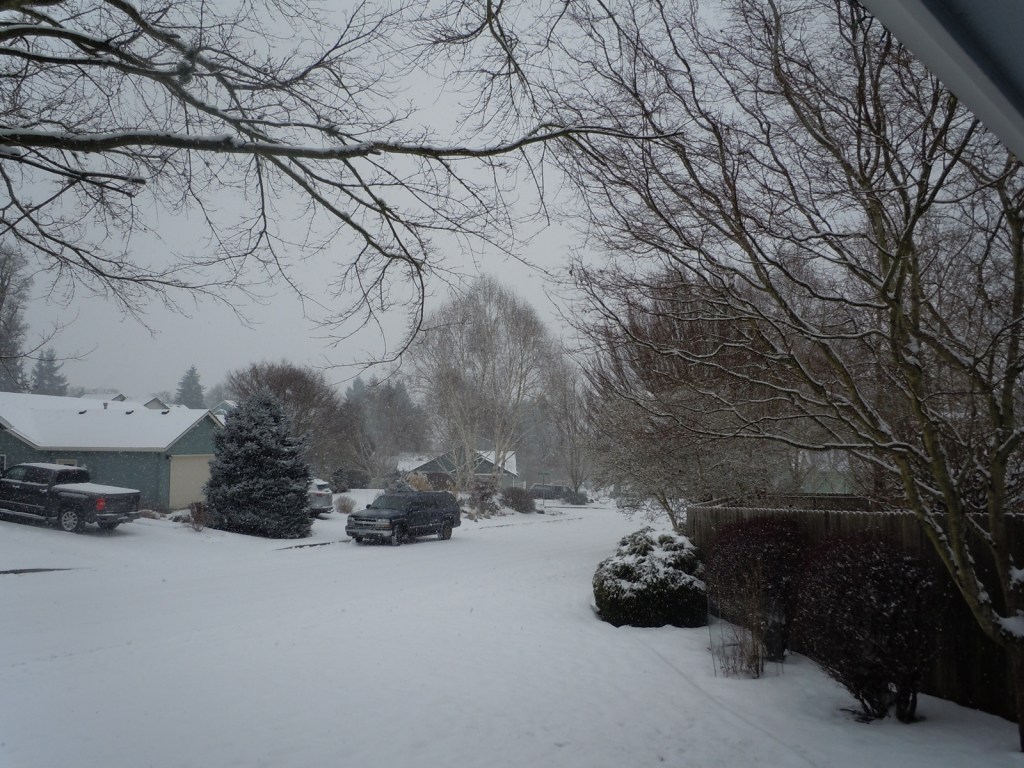
We’re quite miserable during winter, which seems interminable. A few bright days in March or April taunt us, sparking hope that soon dies as rain and gloom return. They say that summer doesn’t arrive until after July 4. It’s often raining on the Independence Day parade.
We tried taking trips during the winters, which works for a few weeks but is a temporary respite. For us, it’s hard to swing for long both financially and dealing with our two cats. So we explored places with sun and warmth during the winter, including Hawaii, Arizona, and California. Love-love-love Hawaii but too expensive and far from family. Arizona might work but didn’t have as much appeal as southern California, where we have family. As former Californians, we’re familiar with the state’s peculiarities and challenges. It was a lengthy process, but we settled on a senior 55+ community called The Colony in Murrieta, CA.
As we’re both well over 55 this is a good choice. Another reason for moving was the new development that sprang up behind our Silverton house over the past 4 years. Initially our back deck looked out over a serene meadow with tall grasses, blackberry vines, and stately spruce trees. We watched deer wend pathways through the meadow and coped with excursions by skunks and raccoons into our yard seeking tidbits. Rather suddenly our little nature preserve disappeared, invaded by clanging and belching heavy equipment digging ugly trenches and scraping away trees and vegetation. What a sad sight! We felt so sorry for animals and the golden eagles that occasionally perched in the tallest spruce.
Quickly there were new streets, house pads, and construction in full swing. Over 40 houses were built, too large for their small lots with painfully repetitious, ugly designs. A cul-de-sac just behind out house attracted a seemingly endless swarm of kids riding bikes, playing hop-scotch, and tossing basketballs into a portable hoop. Our own neighborhood children were never so noisy. Yeah, we’re old curmudgeons but just don ‘t like screeching kids right behind our home—especially during happy hour as we take advantage of the few warm summer days that Oregon has to offer.
Oregon has great wine, by the way. We lived in the Willamette Valley that specializes in world-class pinot noir and other cool tolerant grape varieties such as pinot grigio and chardonnay. But, we’ve not lost access to great wine by moving to Murrieta, twin city to Temecula, one of California’s primo wine producing regions. Due to different climate, Temecula wines are warm weather varieties such as cabernet, merlot, viognier, Spanish and Italian varietals. We’ve already found several outstanding wines such as sangiovese, Montalpulciano, big red blends, and delicious peach-melon viogniers. Not suffering in the wine department! Even joined our first wine club here, Robert Renzoni Vineyards.
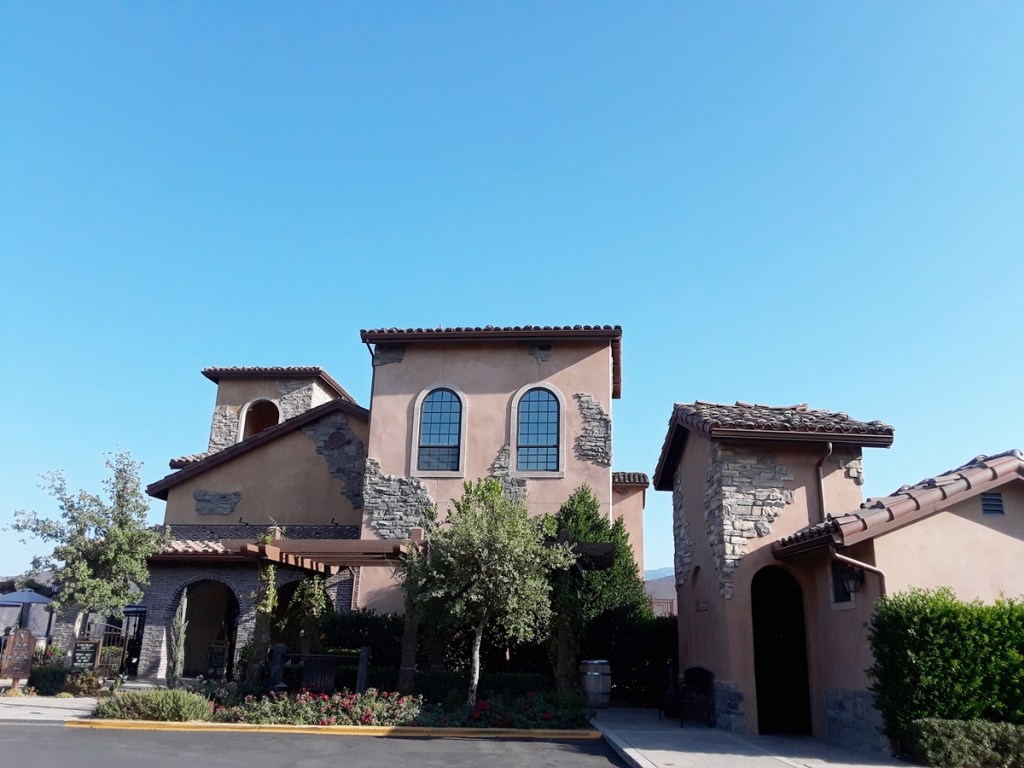

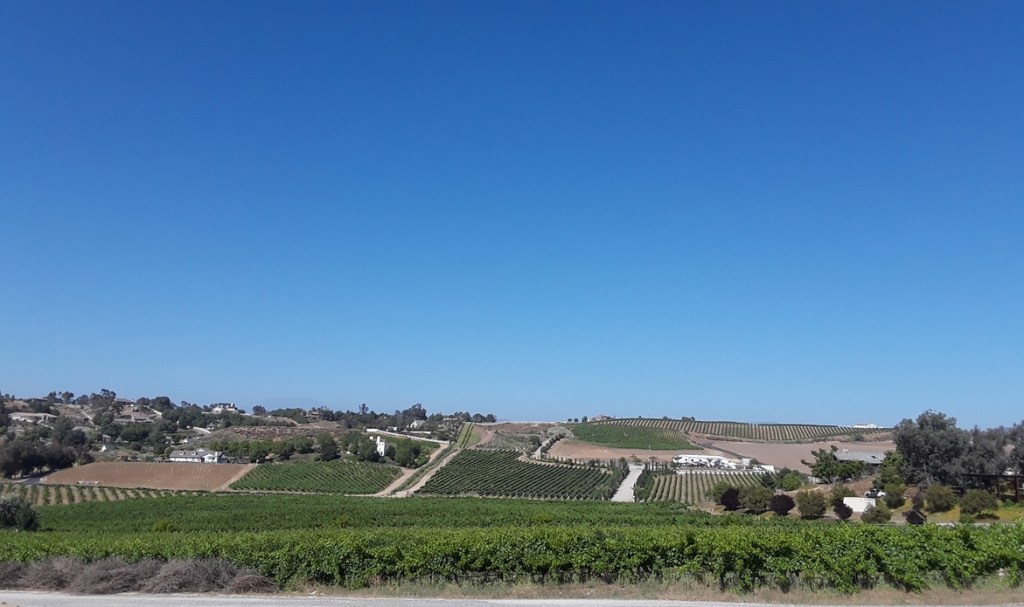
The Colony is a beautiful gated community for active seniors with a large pool and nice golf course (we aren’t golfers but there are several in our family). It comes with the usual amenities, such as clubhouse, gym, tennis courts, bistro, and innumerable activities. At present due to the virus, these facilities have limited use and most activities are canceled. Speaking of Covid-19, we were fortunate to make trips for house searching and the two-day moving ordeal without coming down with it. This area of California takes prevention seriously, nearly everyone wears masks, and businesses follow guidelines for social distancing and limiting customers. We are very appreciative of this.

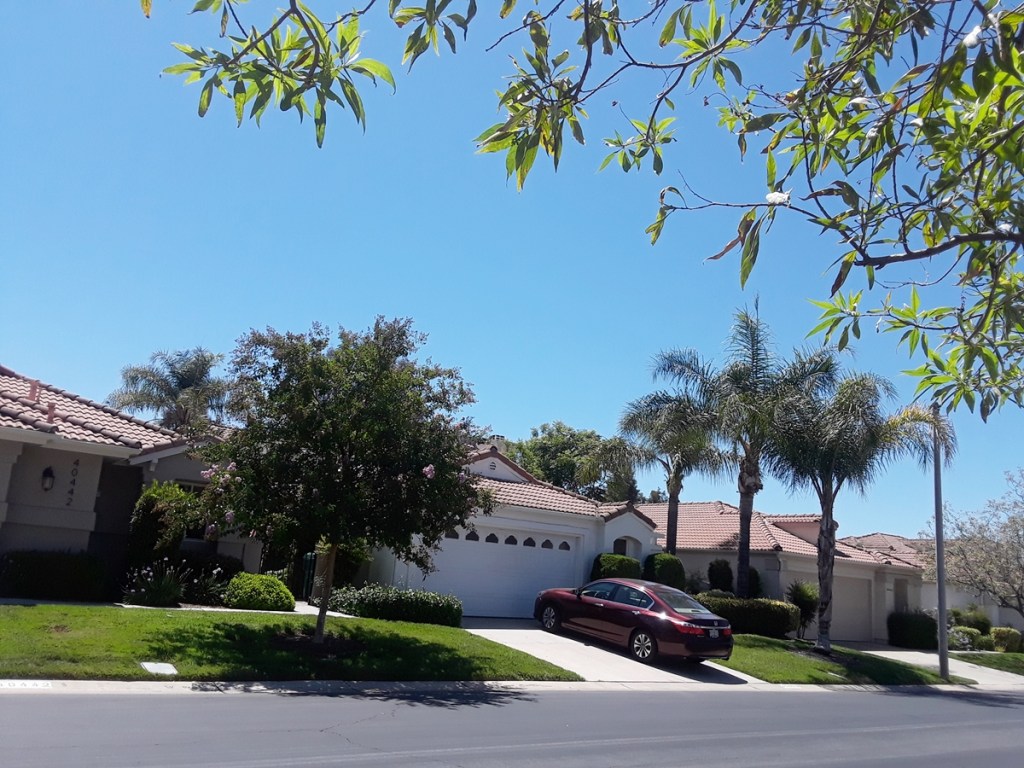

Of course, the noise level around the community is quite low. No more screaming kids! Our back patio feels like an oasis surrounded by tall palms and yew trees giving shade and seclusion. The house stays nicely cool due to thick stucco walls and great air conditioning. Yes, beware what you ask for—we’ve endured two intense heat waves with several days in triple digits. One might say unrelenting sun and blue skies. Not as dry as Palm Springs due to higher elevation (1200 feet), more vegetation, and proximity to the coast about 30 miles west. It’s a reverse weather pattern from Oregon, with two intensely hot months (July, August) and then temperate days with cool nights the rest of the year. Plus lots of bright sunshine.
Well, maybe I’m not so demented after all. Now let’s stay safe and take wise action so this virus pandemic can finally end. Maybe I’ll even get back to writing before too long!

Not much that a good glass of wine can’t fix!
Leonide Martin, Author Historical Fiction

When Authors Must Stay At Home
Most of us are staying home or limiting where and when we go out.

This is an important part of caring about each other and joining together to limit spread of Covid-19 and its harrowing toll of sickness and death. Life as we knew it is suspended for a while. There is much uncertainty about when things will return to any semblance of normal. We’re not able to see our family and friends face-to-face. We keep in touch by social media and phones. Many of us are expanding our comfort with virtual interactions and learning new tricks.
As an author, this “stay at home, stop the spread” reality is both familiar and oddly unsettling. It’s familiar since I already stay home a lot, especially since I’m retired (from a day job) and don’t need to go anywhere regularly. Many of my days were already spent facing my computer screen, doing research and writing. Days could pass without going out anywhere. But when I felt the need to take a break, get some physical activity, go shopping, or socialize with friends, these options were available.

Now they are not. For physical activity, I can take a walk being careful not to approach any other walker closer than six feet. I can do yoga or calisthenics at home—you know just how much appeal that has. For socializing, I can call people or engage in online messaging. That’s OK but not nearly the same as in person discussions. I can do some shopping, but need to put in an online order, hoping what I want is in stock, and set a time for pickup where the clerk puts the groceries inside the trunk. Or else, have things I’ve ordered online dropped off on the porch.

Brave New World indeed!
Now you’d think that an author forced to stay at home would become wildly productive. You envision authors glued to their computers, keying out thousands of words. That new project should be a breeze with so much time. Take on new challenges and spiff up all your social media platforms. Finish those stories. Write amazing blogposts. Submit to awards and contests. Write book reviews by the dozens.
The funny thing is how hard I find it to get motivated. The national crisis has a way of sapping my energy and concentration. I try to avoid watching too much news, but there’s a dreadful fascination with how this pandemic is wreaking havoc across the world. My heart is heavy over such suffering and loss. Silently I urge on the leaders and health workers who contend with the worse of it. Serious concern wells up about workers and families upended as the economy takes a nose dive. We are all affected. We are all—as a planet—in this together. May we find our way through to a more cohesive and caring tomorrow.


Chanticleer Book Reviews Semi-Finalist 2020
The Prophetic Mayan Queen is a Semi-Finalist in Contemporary & Literary Fiction
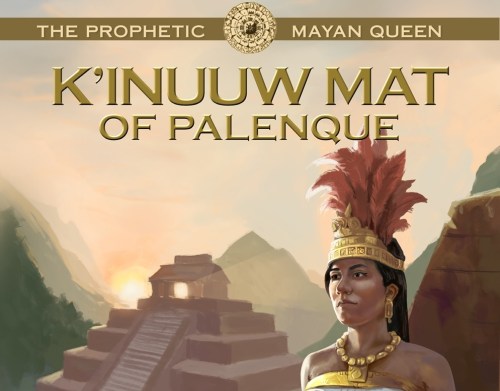
The SOMERSET Book Awards recognize emerging talent and outstanding works in the genre of Literary, Contemporary, and Satire Fiction. The Somerset Book Awards is a genre division of the Chanticleer International Book Awards (The CIBAs).
Chanticleer International Book Awards is looking for the best books featuring contemporary stories, literary themes, adventure, satire, humor, magic realism or women and family themes. These books have advanced to the next judging rounds. The best will advance. Which titles will be declared as winners of the prestigious Somerset Book Awards?
At the Authors Conference in Bellingham, WA, on April 18, 2020 the winners of all divisions of Chanticleer Book Reviews will be announced. It’s very exciting for my latest book to reach the semi-finalist stage! There are 16 semi-finalists in each division. I’ve long thought the names given for these divisions are humorous and entertaining, such as Chaucer Awards for Early HIstorical Fiction, Chatelaine Awards for Romance, Ozma Awards for Fantasy, Cygnus Awards for Science Fiction, Dante Rossetti Awards for Young Adult Fiction, Litle Peeps Award for Early Readers, and more.

Within a division such as Contemporary & Literary Fiction, authors need to choose among subcategories. After pondering this choice I selected two subcategories: Women’s Fiction and Magical Realism. The first is obvious, since the protagonist is a talented and strong girl who develops into a powerful, wise queen with a mandate to preserve her people’s heritage. The second was selected because the Mayan culture has deep themes of mysticism and inter-dimensional realities. Rulers, priestesses, shamans, and healers had frequent interactions with spirit beings such as goddesses and gods, elementals, and ancestors. To the Mayas, this was part of their normal world, so this kind of magic was very real to them.
The Prophetic Mayan Queen: K’inuuw Mat of Palenque has garnered other acknowledgement, such as a 5-star review by Seattle Book Reviews and several praiseworthy editorial reviews. Here’s hoping she wins the Somerset Award which comes with a great Prize Package with lots of publicity!



2020 Tucson Festival of Books – March 14-15

The Tucson Festival of Books is a community-wide celebration of literature. Offered free-of-charge, the festival exists to improve literacy rates among children and adults. Proceeds that remain after festival expenses have been paid are contributed to local literacy programs.
Started in 2009, this gathering of authors and publishers, marketers and sponsors, receives up to 135,000 visitors and features around 500 authors and presenters. Each year event typically includes special programming for children and teens, panels by best-selling and emerging authors, a literary circus, culturally diverse programs, a poetry venue, exhibitor booths and two food courts. Featured authors give talks in various buildings, while in the university mall there are booths for indie authors to meet fans and sell books in 2-hour time periods over the weekend. This year’s festival is March 14-15. You can see the schedule at: http://tucsonfestivalofbooks.org/

Friends have mentioned this book festival, but this is the first year that I’ll be participating. Just needing some warmth and sunshine after one of the most wet, cold, and grey winters in recent Oregonian memory. My books will be featured at the Indie Author Pavilion – Adult Fiction on Sunday, March 15, 2020 from 10 am-12 noon. If you’re in the area, stop by! I’ll be offering discounted book packages on the Mayan Queen series.
Ebook and print books available from Amazon, Barnes & Noble, and your local bookstore by order.

My last trip to Palenque was in 2012. Went to celebrate the 12-21-12 Winter Solstice when the Mayan Calendar ended a great cycle (Mayan Sun or Era) moving from the Fourth to the Fifth Sun. At least, that’s what many said . . . note that the world didn’t end as some predicted. The Mayas of course never said that–to them it was simply one great cycle ending and another beginning.
 leonidemartinblog