
Home » Posts tagged 'Travel'
Tag Archives: Travel

Three Women on a Porch: Story Behind the Picture
When I became the keeper of my family genealogy site, there already was a large photo gallery. Browsing through, I found this photo of three women on the porch of a French Creole cottage-style house. There was no description, but I knew the house was typical of South Louisiana along the Mississippi River, during the late 19th and early 20th centuries. The steps and porch looked vaguely familiar, as though long-ago memories were being tickled. From the women’s hair styles and clothes, I placed the photo around 1910.

I found the picture striking. The older women in the center had a square face and stern expression. Her eyes and brows resembled others I knew in the Martin family. The young woman at left in the photo had a graceful demeanor and lovely profile, studiously reading her book. At the photo’s right, a sprightly young woman with round face and faint smile held a dog in her lap. She was the only one looking at the camera, suggesting she was forthright and engaging. I was so taken by the picture that I chose it for the cover of my family history book, Upriver Families: Acadian Roots and Creole Heritage, co-authored with daughter Katherine Bonnabel and cousin Corinne Martin.
By then I had discovered who the women were. I sent the photo to several family members, and although there was some disagreement, the consensus was that they were Celeste Triche Martin in center, and her two daughters Irma Martin at left and Marie “Keet” Martin at right. Apparently, the photo was in a collection given to cousin Corinne by our aunt Minerva Martin, the family historian before passing that job on. Corinne remembered Aunt Min telling her the matriarch in the center was Celeste Triche Martin, our great-grandmother and our grandfather J.B. Martin Jr.’s mother. J.B. (Jean Baptiste) was brother to Irma and Marie “Keet,” as well as six other siblings. The source of the photo is unknown.
J.B. Martin Sr. was our great-grandfather and husband of Celeste. He was clerk of court for St. Charles Parish and worked in Hahnville. Celeste’s father, J.C. Triche Sr., was editor of the St. Charles Herald and quite influential. In 1883, the sale of property to Celeste Triche Martin was recorded, it was once part of Colonel Richard Taylor’s Fashion Plantation. He was the son of U.S. President Zachary Taylor. After the Civil War, the plantation was sliced into several lots and sold. The Martin family situated a large two-story house built in typical French Creole style there, set well back from the road with a long driveway. The property was 162.66 acres, a long narrow rectangle extending west from the Mississippi River to a wooded, swampy area and the railroad tracks. The river was the main transportation artery and properties commonly came with river access. River Road was constructed in early 1900s but was rough and muddy much of the year.

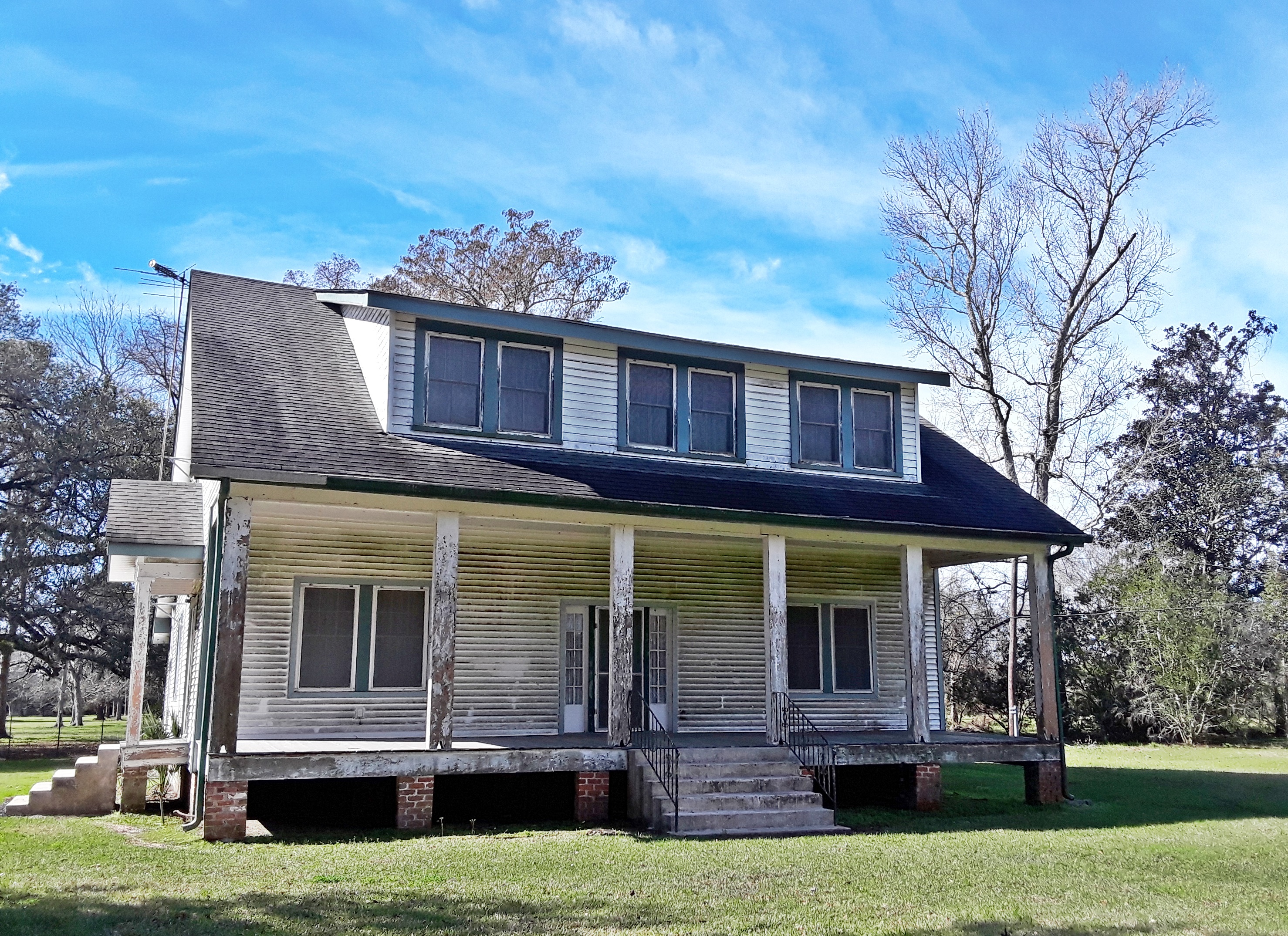
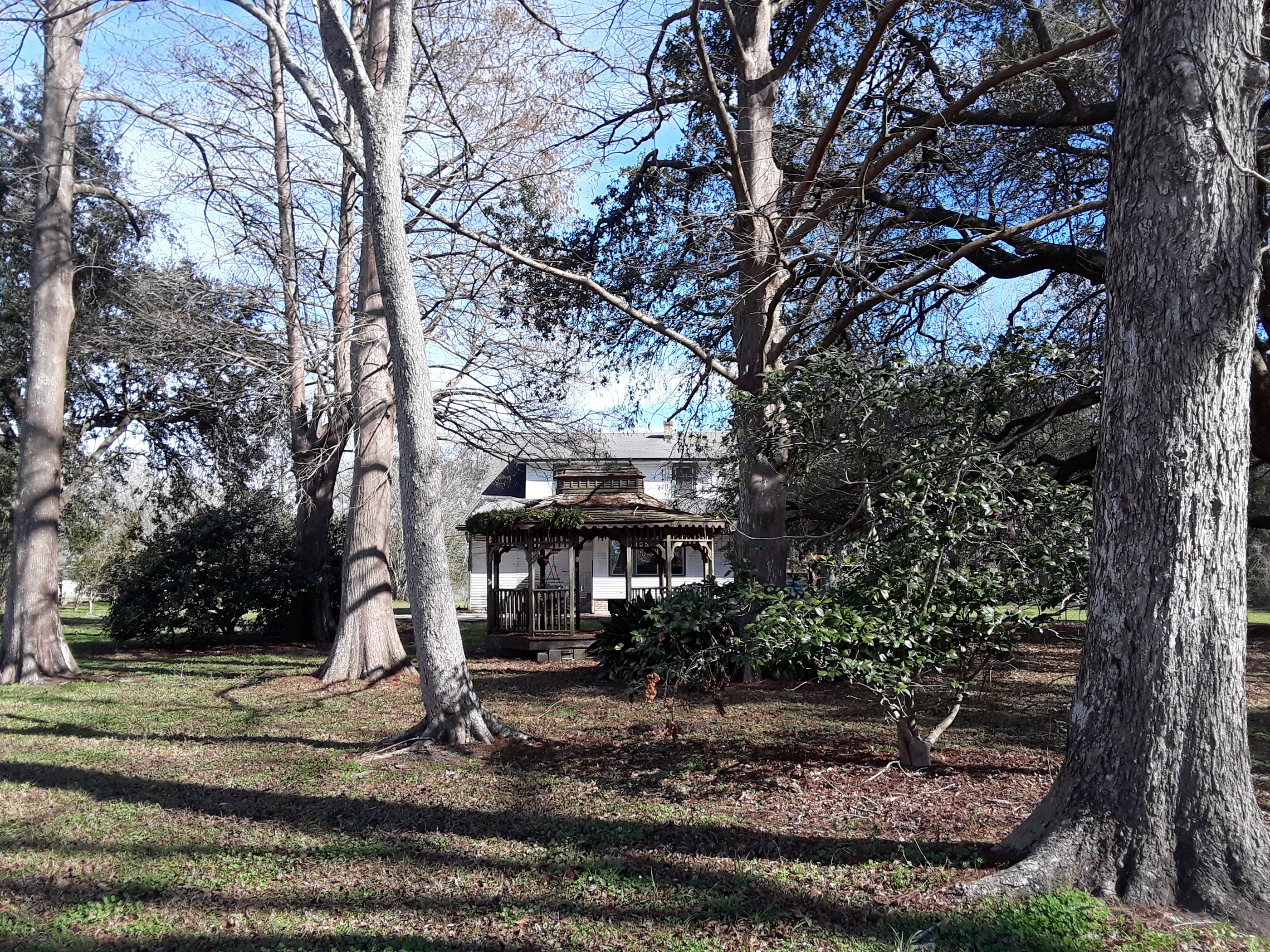
The driveway led from River Road past the house to outbuildings including barn, garage, and storage shed. A porch bounded by railings ran the width in front, and plain square columns supported the roof. Central stairs on which the two daughters are sitting led up to the elevated first floor, and the mother is on the porch. Creole cottages typically had living and dining rooms on the first floor, and bedrooms on the second. Behind was an extension containing the kitchen, bathrooms, pantry, and storage. Two chimneys rose above the roof venting fireplaces. Later a three-window dormer was added to brighten the upstairs bedrooms.
Celeste’s husband died unexpectedly in 1897 at age 50, still holding office as parish clerk. Our grandfather J.B. Martin Jr. was 16 years old. Celeste managed the household and raised the six young children, assisted by her large extended family. She lived to see the new century and the success of two children: J.B. became superintendent of schools for St. Charles Parish for 31 years, and Marie “Keet” became a noted teacher, band director, and principal in the public school system for 41 years.
Irma married Leon Charles Vial I in 1902. His family owned adjacent property that was part of Fashion Plantation. He was a leading politician and sheriff for 22 years, initiating the “Vial Era” in parish politics. Holding public office on 10 different occasions, he never lost an election. Sheriff Vial’s sister Leonide Mary Vial (our grandmother) married Irma’s brother J.B. Martin Jr. in 1903. Called a “double marriage” in local parlance, this intertwined the Martin and Vial families in multiple ways. The couples were double in-laws and their children double first cousins.
Irma died in 1913 and Leon remarried the widow Marie Keller, whose family owned Home Place, a nearby plantation. Celeste died in 1924 at age 72. The house on River Road in Hahnville became home of Marie “Keet,” the youngest daughter, and her husband Laurent J. Labry. They adopted two children, grew orchids in a hothouse, and after Marie died in 1981, the house was sold. It was neglected for years, until a Vial family member bought it in 2020. Renovation was begun but put on hold by Hurricane Ida. Now boarded up with stabilized foundation, the old Creole cottage awaits renewal.



Guest Blogpost by Amanda Jayne

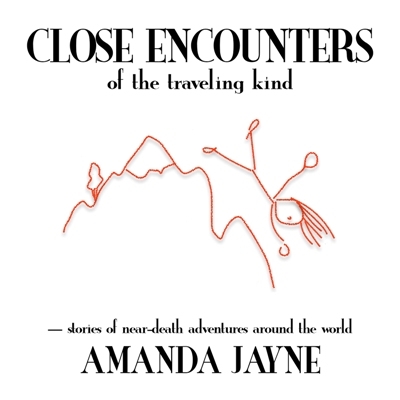
I’m delighted to host Amanda Jayne, intrepid author of Close Encounters of the Traveling Kind, stories of her near-death travel adventures in some of the world’s most exotic and unusual places. Jayne was inspired during her youth by a teacher, and always yearned for far-away places. She began these travels in the late teens-early twenties, and had much to learn about staying safe and well in foreign lands. In this humorous and gripping book, Jayne gives vivid descriptions of hair-raising escapades and provides wit and wisdom through “lessons learned” and”tips on how not to die” should other travelers be brave enough to follow her steps.
Below are Jayne’s thoughts about why she sought travel around the world and what traveling means to her. My review of her book follows. —Leonide Martin

Amanda Jayne
I’ve been fascinated by other cultures and countries since I was young. I’m not sure what it is inside me that draws me to them but it’s some kind of magnetic power that pulls at me. I remember pouring over the atlas we had on the bookshelves in my home. It was bigger than I was at the time, at least that’s how I remember it. I would follow the lines and contours of the countries wondering what and who they held inside them. One Christmas I received a large book of mysterious places of the world. Inside were photos of places like Machu Picchu, the Nazca lines and Easter Island. I traveled the world in the pages of this book, from England to Australia, Peru, Mexico, China and beyond. I could feel the energy of each place as I pored over the pictures and read about the countries and I knew that one day I would travel and see them. At school, some of the kids laughed at my idea of traveling and told me I was going to be the first to marry, settle down with 2.4 kids and abandon my travel plans. “Anyway,” they said, “There’s no way you could do it, it’s too difficult.” Then I met Mrs. Joseph.
In my book I have written about Mrs. Joseph in the introduction. She was my English teacher, originally from Myanmar and had lived in several countries that seemed so exotic to me as a teenager. She taught me that travel was not only possible, but that experiencing other countries and cultures was an essential part of life. The stories she shared with me were of strange animals in India making impossible leaps across wide roads in the dead of night, or of her friend who was cursed by an Indian man and told he would die at 22 – and he did (“this was simply because he believed her, the man was not magic”, Mrs. Joseph would say, “your mind is strong, you can use it to help yourself or hurt yourself.”) She spoke casually of her countless miraculous escapes from death, mostly at the hands of cars that ran her over in different ways but also of other strange co-incidences in which her life was saved.
As I look back now, her strongest influence on me was her causing me to begin to see the world around me differently. She wasn’t sharing her strange stories for the drama or to provoke a reaction, she was genuinely concerned that I see that there was more to life than the school walls and learning facts. Mrs. Joseph was a strict teacher, not impressed by nonsense and prone to giving out detentions to those who used the words, nice and a lot in essays (“they are not real words; they don’t say anything to me. Use a word that means something!”). Outside the classroom though, she taught me there is more to life than meets the eye, that the things you need in life will turn up at the exact moment you need them (if they don’t, you didn’t need them) and that the magic and mystery is all around us, right here, in the natural world and in the way we can interact with it, if only we are willing to see. I say ‘she taught me’ but really she told me and encouraged me because these are things you can only learn from experience, and travel is one of the best ways to learn because it tends to put you in unusual places and situations that make you look more clearly and deeply into the world.
Armed with all I’d learned from my favourite teacher and all I’d dreamed of from my books (pre-Google days!) I started traveling. The first thing I noticed was that it is easier than it looks – like anything in life, the thoughts and fears about doing something are most often the toughest part. Once you commit and start, the way opens up for you. I didn’t intend for anything to be ‘adventurous’ travel, I simply wanted to see and explore the world. I’m not an adrenalin junkie and even refused to bungee jump when I was already in the queue at the famous bridge in New Zealand where it all began – I am afraid of heights, can’t swim and when I saw people returning with burst blood vessels in their eyes I felt ok with backing out. However, I am happy to take risks when there is an encounter I really want, a place I long to see or I know I will grow and learn from the experience.
Any travel outside of resorts and hotels is going to bring strange circumstances and adventure primarily because we are in an alien environment. I find that being in foreign cultures where I don’t have a clue what people are saying and I have no idea what is going on makes me feel alive. It stirs something within that wakes me up and causes me to look differently at the world and the people around me. I am more in the present moment during those times, I have the kind of wonder a child must feel when she sees a flower for the first time and is in awe of it. I love that, and I adore the feeling of expansion that comes over me when I am in the presence of a place or creation that has enormous energy.
Mostly, the experiences I write about in the book simply come from exploring places that were fascinating to me. I have worked in an orphanage and an English school in Bolivia, lived in Japan for five years and walked 1,200km alone around the 88 temple pilgrimage on Shikoku. In India I’ve been stalked by a man who shouted at me wherever I went for several days (“You are crap madam, crap!”) and given a bunch of grapes by a Sadhu (wandering holy man) when I had my pack stolen. It was his only possession in the world and his selfless compassion reached out to me as I cried over the loss of my backpack and helped me see clearly again. I’ve nearly come a cropper in Peru, Bolivia, Japan, Thailand, Nepal and South Africa. All of these experiences have taught me valuable lessons about who I am, how I want to be and how I can live more fully and peacefully in this wonderful world.
Now I understand that just living each day, no matter where you are, can be an adventure if you approach life with wonder and awe. It’s true I’m not being attacked by snakes in my bedroom in Kent or chased out of a makeshift drinking tavern by several angry tribesmen, but there is magic and adventure to be found in life wherever you are. And there are always more countries and cultures to explore… I’d better start packing. — Amanda Jayne
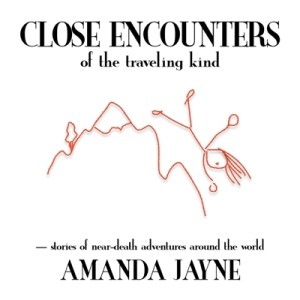 Close Encounters of the Traveling Kind by Amanda Jayne
Review by Leonide Martin
Hair-raising travel adventures told with wit and brevity.
For those who love traveling, Close Encounters of the Traveling Kind will provide both uproarious amusement and cautionary tales. Inspired by a teacher, Jayne seeks out some of the world’s most exotic and unusual places for adventurous travels. She narrowly escapes death from altitude sickness on Mt. Fuji, getting lost in the Amazon, a vengeful snake in Thailand, freezing on the way to Machu Picchu, typhoid and salmonella in La Paz, and falling down a ravine bicycling the Death Road in Bolivia. From each near mishap, she culls wisdom and humor, leaving lessons learned for those daring enough to follow her steps.
Her mishaps in South Africa while taking local native buses to Lesotho to ride mountain ponies are downright terrifying. Only a naive 20-something would attempt such dangerous travel alone. A solo white woman in a sea of black faces during the upheaval following the fall of Apartheid, Jayne is nearly kidnapped, assaulted, and threatened with death. From these she learned to listen to her gut, mistrust local advice, take food and water, and watch for the “guardian angel,” a large native woman who took her under a wing to safety.
The last adventure proved to be truly numinous. Rafting the Bhote Kosi River in Nepal, Jayne is thrown from her raft into Class 5 rapids and sucked into a whirlpool. In the near-death experience, she entered a divine calm, her mind stilled and everything crystal clear. But the whirlpool released her to live for yet another adventure. Her lesson learned there perhaps sums up Jayne’s approach to travel close encounters: “Let go, life has got me.” Written with brevity, wit, and gripping description, any adventurous traveler will enjoy—though probably not emulate—these travel stories.
 leonidemartinblog